- 参考文献:
VAE整体说明
- 变分自编码器(Variational Auto-Encoder,VAE)是一种生成式模型,在机器学习和深度学习领域有广泛应用
VAE的问题设定
- 给定观测数据 \( \mathbf{x} \),假设其由隐变量 \( \mathbf{z} \) 生成,联合分布为 \( p_\theta(\mathbf{x}, \mathbf{z}) = p_\theta(\mathbf{x}|\mathbf{z}) p(\mathbf{z}) \),其中:
- \( p(\mathbf{z}) \) 是隐变量的先验分布(通常为标准正态 \( \mathcal{N}(0, I) \))
- \( p_\theta(\mathbf{x}|\mathbf{z}) \) 是生成模型(解码器),参数为 \( \theta \)
- 目标:最大化观测数据的边际似然 \( p_\theta(\mathbf{x}) = \int p_\theta(\mathbf{x}|\mathbf{z}) p(\mathbf{z}) d\mathbf{z} \),但积分难计算
一些设想(基本推导思路,可以跳过)
- 为了最大化概率 \(\sum_{x}\log P(x)\),可先进行如下推导:
$$
\begin{align}
L&=\sum_{x}\log P(x)\\
&=\int_{z}q(z|x)\cdot\log P(x)dz\\
&=\int_{z}q(z|x)\cdot\log\left(\frac{p(z,x)}{p(z|x)}\right)dz\\
&=\int_{z}q(z|x)\cdot\log\left(\frac{p(z,x)}{q(z|x)}\cdot\frac{q(z|x)}{p(z|x)}\right)dz\\
&=\int_{z}q(z|x)\cdot\log\left(\frac{p(z,x)}{q(z|x)}\right)dz+\underbrace{\int_{z}q(z|x)\cdot\log\left(\frac{q(z|x)}{p(z|x)}\right)dz}_{KL(q(z|x)||p(z|x))\geq0}\\
&\geq\int_{z}q(z|x)\cdot\log\left(\frac{p(z,x)}{q(z|x)}\right)dz\\
&=\int_{z}q(z|x)\cdot\log\left(\frac{p(x|z)\cdot p(z)}{q(z|x)}\right)dz\\
&=\underbrace{\int_{z}q(z|x)\cdot\log(p(x|z))dz}_{Entropy}+\underbrace{\int_{z}q(z|x)\cdot\log\left(\frac{p(z)}{q(z|x)}\right)dz}_{-KL(q(z|x)||p(z))}
\end{align}
$$- 上述推导说明,最大化似然函数 \(L = \sum_{x}\log P(x)\) 可变成最大化:
$$L’ = \int_{z}q(z|x)\cdot\log(p(x|z))dz + \int_{z}q(z|x)\cdot\log\left(\frac{p(z)}{q(z|x)}\right)dz$$- 实际上,后续会提到 \(L’\) 就是 \(L\) 的变分下界
- 上述推导说明,最大化似然函数 \(L = \sum_{x}\log P(x)\) 可变成最大化:
VAE的推导
- 引入变分分布 \( q_\phi(\mathbf{z}|\mathbf{x}) \)(编码器),近似真实后验 \( p_\theta(\mathbf{z}|\mathbf{x}) \),参数为 \( \phi \)。通过最小化 \( q_\phi(\mathbf{z}|\mathbf{x}) \) 与 \( p_\theta(\mathbf{z}|\mathbf{x}) \) 的KL散度:
$$
\min_{\phi} D_{\text{KL} }\left(q_\phi(\mathbf{z}|\mathbf{x}) | p_\theta(\mathbf{z}|\mathbf{x})\right)
$$ - 展开KL散度:
$$
D_{\text{KL} }\left(q_\phi(\mathbf{z}|\mathbf{x}) | p_\theta(\mathbf{z}|\mathbf{x})\right) = \mathbb{E}_{q_\phi(\mathbf{z}|\mathbf{x})} \left[ \log q_\phi(\mathbf{z}|\mathbf{x}) - \log p_\theta(\mathbf{z}|\mathbf{x}) \right]
$$ - 利用贝叶斯公式 \( p_\theta(\mathbf{z}|\mathbf{x}) = \frac{p_\theta(\mathbf{x}|\mathbf{z}) p(\mathbf{z})}{p_\theta(\mathbf{x})} \),代入得:
$$
D_{\text{KL} }\left(q_\phi(\mathbf{z}|\mathbf{x}) | p_\theta(\mathbf{z}|\mathbf{x})\right) = \mathbb{E}_{q_\phi(\mathbf{z}|\mathbf{x})} \left[ \log q_\phi(\mathbf{z}|\mathbf{x}) - \log p_\theta(\mathbf{x}|\mathbf{z}) - \log p(\mathbf{z}) \right] + \log p_\theta(\mathbf{x})
$$ - 整理后得到:
$$
\log p_\theta(\mathbf{x}) - D_{\text{KL} }\left(q_\phi(\mathbf{z}|\mathbf{x}) | p_\theta(\mathbf{z}|\mathbf{x})\right) = \mathbb{E}_{q_\phi(\mathbf{z}|\mathbf{x})} \left[ \log p_\theta(\mathbf{x}|\mathbf{z}) \right] - D_{\text{KL} }\left(q_\phi(\mathbf{z}|\mathbf{x}) | p(\mathbf{z})\right)
$$
证据下界(ELBO)
- 证据下界(Evidence Lower Bound, ELBO),也称为变分下界(Variational Lower Bound, VLB)
- 由于 \( D_{\text{KL} } \geq 0 \),有:
$$
\log p_\theta(\mathbf{x}) \geq \underbrace{\mathbb{E}_{q_\phi} \left[ \log p_\theta(\mathbf{x}|\mathbf{z}) \right] - D_{\text{KL} }\left(q_\phi(\mathbf{z}|\mathbf{x}) | p(\mathbf{z})\right)}_{\text{ELBO}(\theta, \phi)}
$$ - 目标转为最大化ELBO:
$$
\mathcal{L}(\theta, \phi; \mathbf{x}) = \mathbb{E}_{q_\phi(\mathbf{z}|\mathbf{x})} \left[ \log p_\theta(\mathbf{x}|\mathbf{z}) \right] - D_{\text{KL} }\left(q_\phi(\mathbf{z}|\mathbf{x}) | p(\mathbf{z})\right)
$$- 此时,最大化ELBO \(\mathcal{L}(\theta, \phi; \mathbf{x})\) 就可以实现最大化原始对数似然函数目标 \(\log p_\theta(\mathbf{x})\)
- ELBO的更多等价形式见附录
损失函数分解(ELBO包含两项)
1. 重构项(Reconstruction Term)最大化 :
$$
\mathbb{E}_{q_\phi(\mathbf{z}|\mathbf{x})} \left[ \log p_\theta(\mathbf{x}|\mathbf{z}) \right]
$$- 作用:鼓励解码器重建输入数据,通常用均方误差(MSE)或交叉熵实现
- 理解:最大化\(\mathbb{E}_{q_\phi(\mathbf{z}|\mathbf{x})} \left[ \log p_\theta(\mathbf{x}|\mathbf{z}) \right]\)等价于上面的公式等价于:
- 从原始数据集 \(\mathcal{D}\) 任意采样一个数据 \(\mathbf{x}_0\);
- 经过编码器 \(q_\phi(\mathbf{z}|\mathbf{x})\) 将 \(\mathbf{x}_0\) 编码成 \(\mathbf{z}\),其中 \(\mathbf{z} \sim q_\phi(\mathbf{z}|\mathbf{x}_0)\);
- 再经过解码器 \(p_\theta(\mathbf{x}|\mathbf{z})\) 将编码器的输出 \(\mathbf{z}\) 解码成 \(\mathbf{x}_i\)
- 最大化 \(\log p_\theta(\mathbf{x}|\mathbf{z})\),等价于最小化 \(\mathbf{x}_i\) 和 \(\mathbf{x}_0\) 的距离(常用交叉熵损失或者MSE)
2. 正则项(KL Divergence Term)最小化 :
$$
D_{\text{KL} }\left(q_\phi(\mathbf{z}|\mathbf{x}) | p(\mathbf{z})\right)
$$- 作用:约束编码器输出接近先验分布 \( p(\mathbf{z}) \),避免过拟合
- 理解:先验分布 \( p(\mathbf{z}) \)可以设定为任意我们方便采样的值,比如VAE中将其设定为标准正态分布 \(\mathcal{N}(0, I) \)
KL散度的闭式解
- 假设 \( p(\mathbf{z}) = \mathcal{N}(0, I) \),且 \( q_\phi(\mathbf{z}|\mathbf{x}) = \mathcal{N}(\mu_\phi(\mathbf{x}), \sigma_\phi^2(\mathbf{x}) I) \),则KL散度有闭式解:
$$
D_{\text{KL} }\left(q_\phi(\mathbf{z}|\mathbf{x}) | p(\mathbf{z})\right) = -\frac{1}{2} \sum_{j=1}^J \left(1 + \log \sigma_j^2 - \mu_j^2 - \sigma_j^2\right)
$$- 其中 \( J \) 是隐变量维度
- 证明过程见附录
重参数化技巧(Reparameterization Trick)
- 为可微分地采样 \( \mathbf{z} \sim q_\phi(\mathbf{z}|\mathbf{x}) \),令:
$$
\mathbf{z} = \mu_\phi(\mathbf{x}) + \sigma_\phi(\mathbf{x}) \odot \epsilon, \quad \epsilon \sim \mathcal{N}(0, I)
$$- 使得梯度可回传
最终损失函数(负 ELBO)
- 总损失函数 :
$$
\mathcal{L}_{\text{VAE} }(\theta, \phi; \mathbf{x}) = \underbrace{\mathbb{E}_{q_\phi(\mathbf{z}|\mathbf{x})} \left[ -\log p_\theta(\mathbf{x}|\mathbf{z}) \right]}_{\text{Reconstruction Loss} } + \underbrace{D_{\text{KL} }\left(q_\phi(\mathbf{z}|\mathbf{x}) | p(\mathbf{z})\right)}_{\text{KL Divergence} }
$$- 重构损失采用 MSE 或交叉熵损失函数:
$$
\text{Reconstruction Loss} = |\mathbf{x} - \text{Decoder}(\text{Encoder}(\mathbf{x}))|_2^2
$$ - KL 散度闭式解(假设 \( q_\phi(\mathbf{z}|\mathbf{x}) = \mathcal{N}(\mu, \sigma^2) \)):
$$
D_{\text{KL} }\left(q_\phi(\mathbf{z}|\mathbf{x}) | p(\mathbf{z})\right) = - \frac{1}{2} \sum_{j=1}^J \left( 1 + \log \sigma_j^2 - \mu_j^2 - \sigma_j^2 \right)
$$- 其中 \( J \) 是隐变量维度
- 重构损失采用 MSE 或交叉熵损失函数:
- 最终,VAE的最终版MSE版损失函数为:
$$
\begin{align}
\mathcal{L}_{\text{VAE} }(\theta, \phi; \mathbf{x}) &= \text{Reconstruction Loss} + D_{\text{KL} }\left(q_\phi(\mathbf{z}|\mathbf{x}) | p(\mathbf{z})\right) \\
&= |\mathbf{x} - \text{Decoder}(\text{Encoder}(\mathbf{x}))|_2^2 - \frac{1}{2} \sum_{j=1}^J \left( 1 + \log \sigma_j^2 - \mu_j^2 - \sigma_j^2 \right)
\end{align}
$$ - 总体来说:VAE通过最大化ELBO,同时优化生成模型 \( p_\theta(\mathbf{x}|\mathbf{z}) \) 和推断模型 \( q_\phi(\mathbf{z}|\mathbf{x}) \),平衡了数据重建与隐变量正则化
VAE网络结构
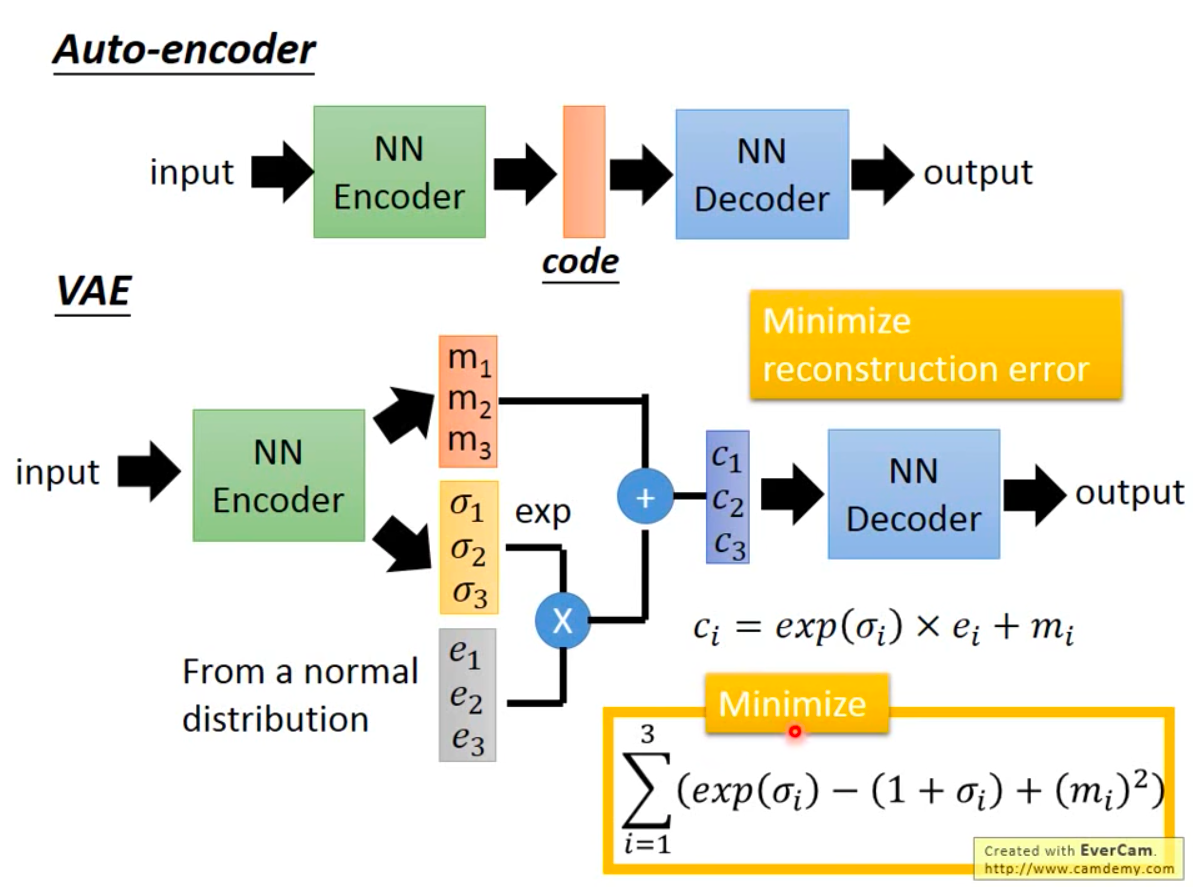
- 下面的网络输出对数方差(能保证方差非负),但是仍然使用 \(\sigma\),容易让人误解,此时使用 \(e^\sigma\) 表示方差,此时有 \(\sigma\) 就是对数方差(原\(\log \sigma^2\))
AE-VAE-CVAE
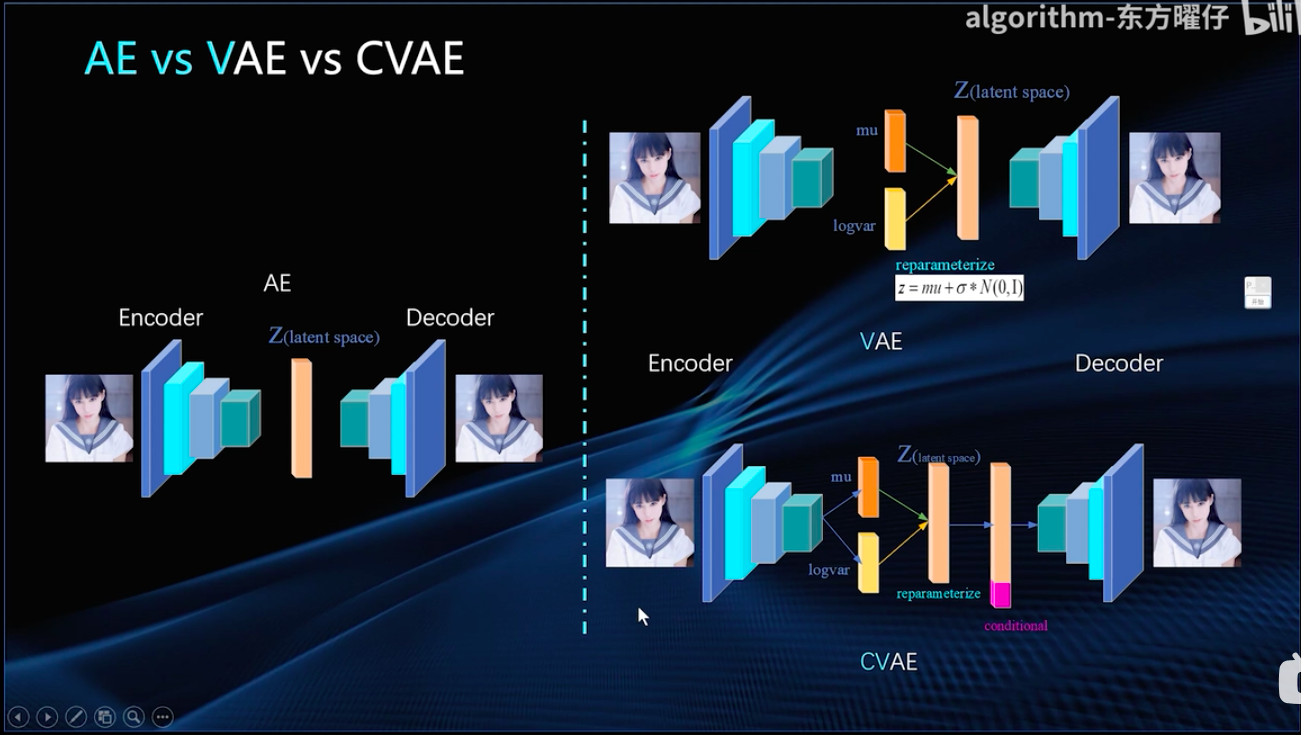
- AE-VAE-CVAE结构差异:
VAE的简单代码实现
- 代码实现如下:
1
2
3
4
5
6
7
8
9
10
11
12
13
14
15
16
17
18
19
20
21
22
23
24
25
26
27
28
29
30
31
32
33
34
35
36
37
38
39
40
41
42
43
44
45
46
47
48
49
50
51
52
53
54
55
56
57
58
59
60
61
62
63
64
65
66
67
68
69
70
71
72
73
74
75
76
77
78
79
80
81
82
83
84
85
86
87
88
89
90
91
92
93
94
95
import torch
import torch.nn as nn
import torch.optim as optim
from torchvision import datasets, transforms
import torchvision.utils as vutils
import matplotlib.pyplot as plt
# 定义 VAE 模型
class VAE(nn.Module):
def __init__(self, input_size, hidden_size=400, latent_size=20):
super(VAE, self).__init__()
# 编码器
self.fc1 = nn.Linear(input_size, hidden_size)
self.fc_mu = nn.Linear(hidden_size, latent_size)
self.fc_logvar = nn.Linear(hidden_size, latent_size)
# 解码器
self.fc2 = nn.Linear(latent_size, hidden_size)
self.fc3 = nn.Linear(hidden_size, input_size)
def encode(self, x):
h = torch.relu(self.fc1(x))
return self.fc_mu(h), self.fc_logvar(h)
def reparameterize(self, mu, logvar):
std = torch.exp(0.5 * logvar)
eps = torch.randn_like(std)
return mu + eps * std
def decode(self, z):
h = torch.relu(self.fc2(z))
return torch.sigmoid(self.fc3(h))
def forward(self, x):
mu, logvar = self.encode(x.view(-1, 784))
z = self.reparameterize(mu, logvar)
return self.decode(z), mu, logvar
# 定义损失函数
def loss_function(recon_x, x, mu, logvar):
BCE = nn.functional.binary_cross_entropy(recon_x, x.view(-1, 784), reduction='sum')
KLD = -0.5 * torch.sum(1 + logvar - mu.pow(2) - logvar.exp())
return BCE + KLD
# 训练函数
def train(model, train_loader, optimizer, epoch):
model.train()
train_loss = 0
for batch_idx, (data, _) in enumerate(train_loader):
data = data.to(device)
optimizer.zero_grad()
recon_batch, mu, logvar = model(data)
loss = loss_function(recon_batch, data, mu, logvar)
loss.backward()
train_loss += loss.item()
optimizer.step()
print(f'====> Epoch: {epoch} Average loss: {train_loss / len(train_loader.dataset):.4f}')
# 生成图片函数
def generate_image(model, device):
model.eval()
with torch.no_grad():
z = torch.randn(1, 20).to(device)
sample = model.decode(z).cpu()
sample = sample.view(1, 1, 28, 28)
vutils.save_image(sample, 'generated_image.png')
plt.imshow(sample.squeeze().numpy(), cmap='gray')
plt.show()
# 数据加载
transform = transforms.Compose([
transforms.ToTensor()
])
train_dataset = datasets.MNIST(root='./data', train=True, transform=transform, download=True)
train_loader = torch.utils.data.DataLoader(train_dataset, batch_size=128, shuffle=True)
# 设备配置
device = torch.device("cuda" if torch.cuda.is_available() else "cpu")
# 初始化模型、优化器
model = VAE(input_size=784).to(device)
optimizer = optim.Adam(model.parameters(), lr=1e-3)
# 训练模型
num_epochs = 10
for epoch in range(1, num_epochs + 1):
train(model, train_loader, optimizer, epoch)
# 生成图片
generate_image(model, device)
附录:VAE李宏毅公式推导
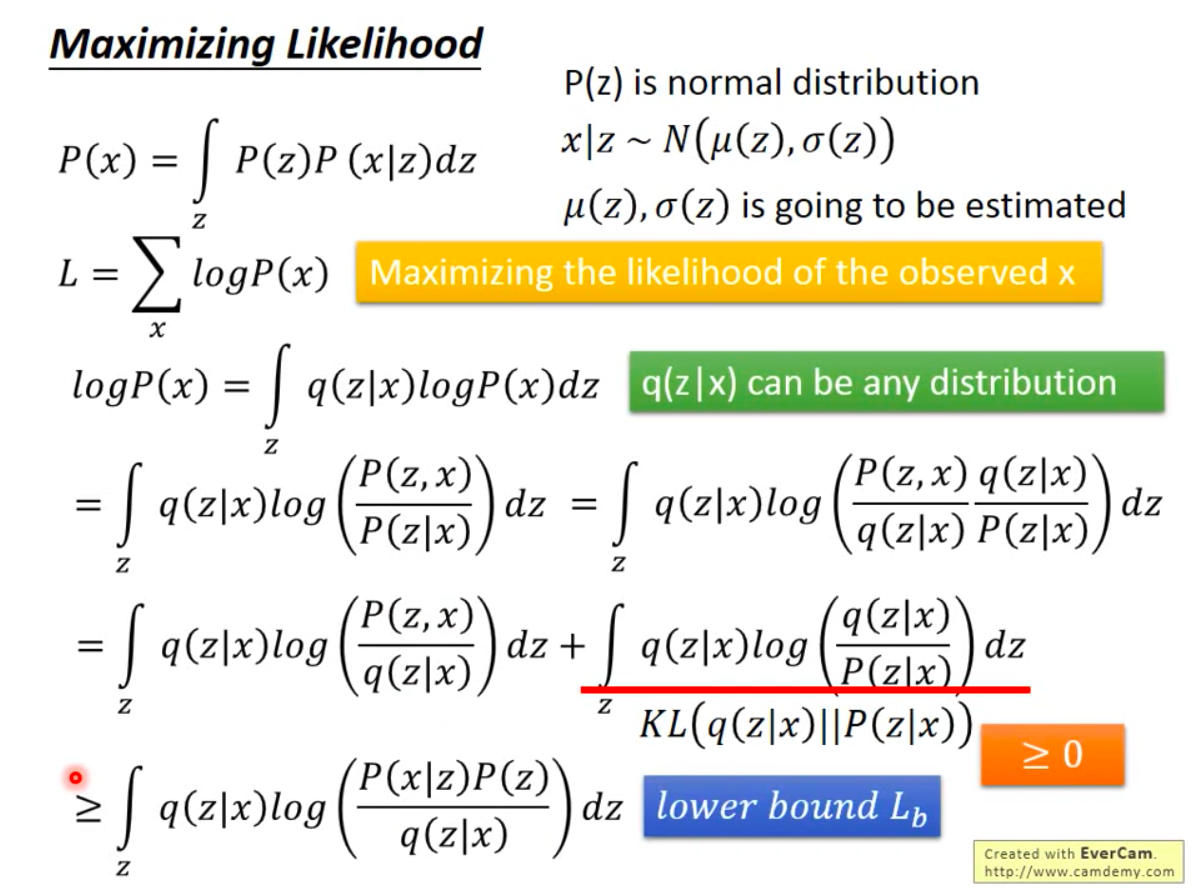
- 目标是让似然函数最大化,也就是最大化 \(\sum_x \log P(x)\),推导可得相当于最大化变分下界(Evidence Lower Bound, \(ELBO(q)\))
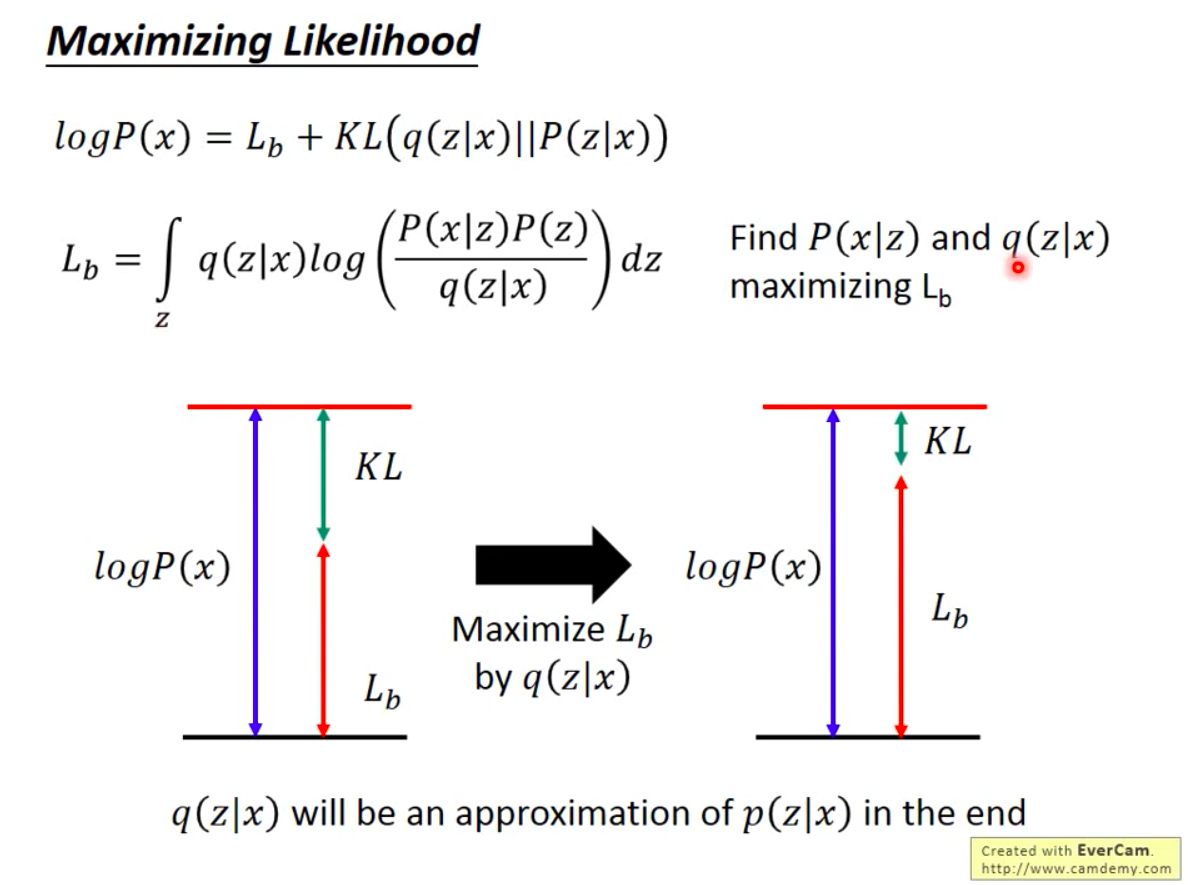
- 为什么要通过求解 \(q\) 来实现似然函数最大化/ELBO最大化呢?因为优化 \(q\) 时,与 \(P(x)\) 无关,相当于最小化KL散度
- 进一步拆解变分下界
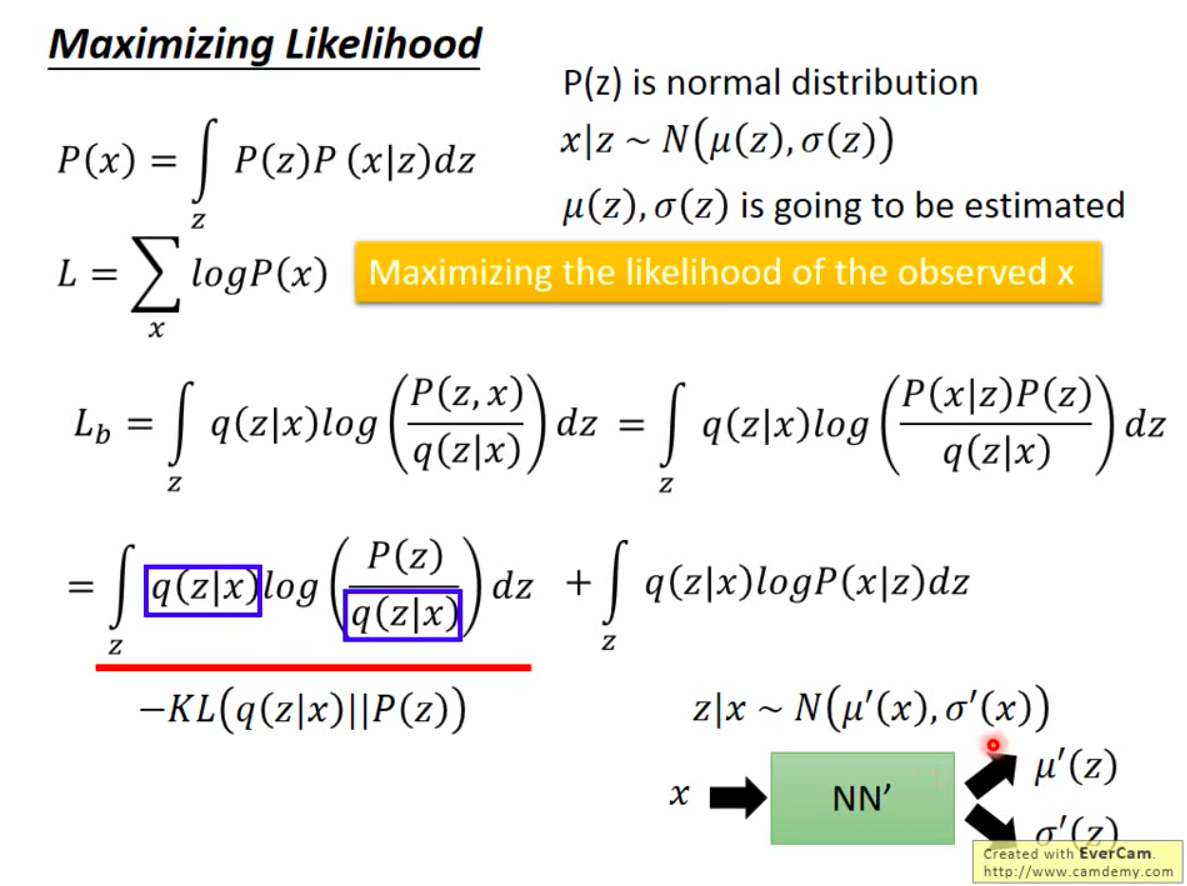
- 变分下界的两个部分分别可用在网络中建模,两个损失函数同时优化就是VAE
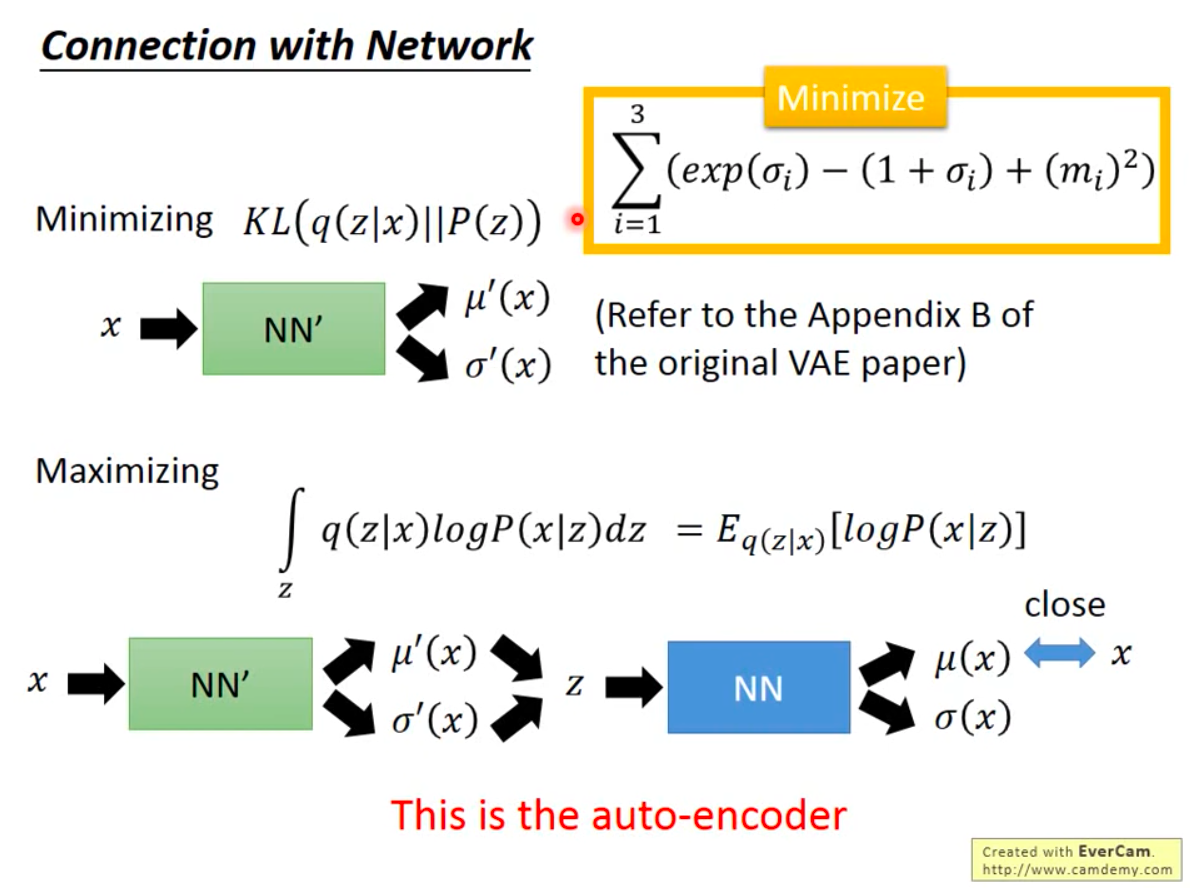 * 期望部分:通过带采样的Auto-Encoder实现,损失函数为Auto-Encoder的损失函数
附录:KL散度闭市解的推导
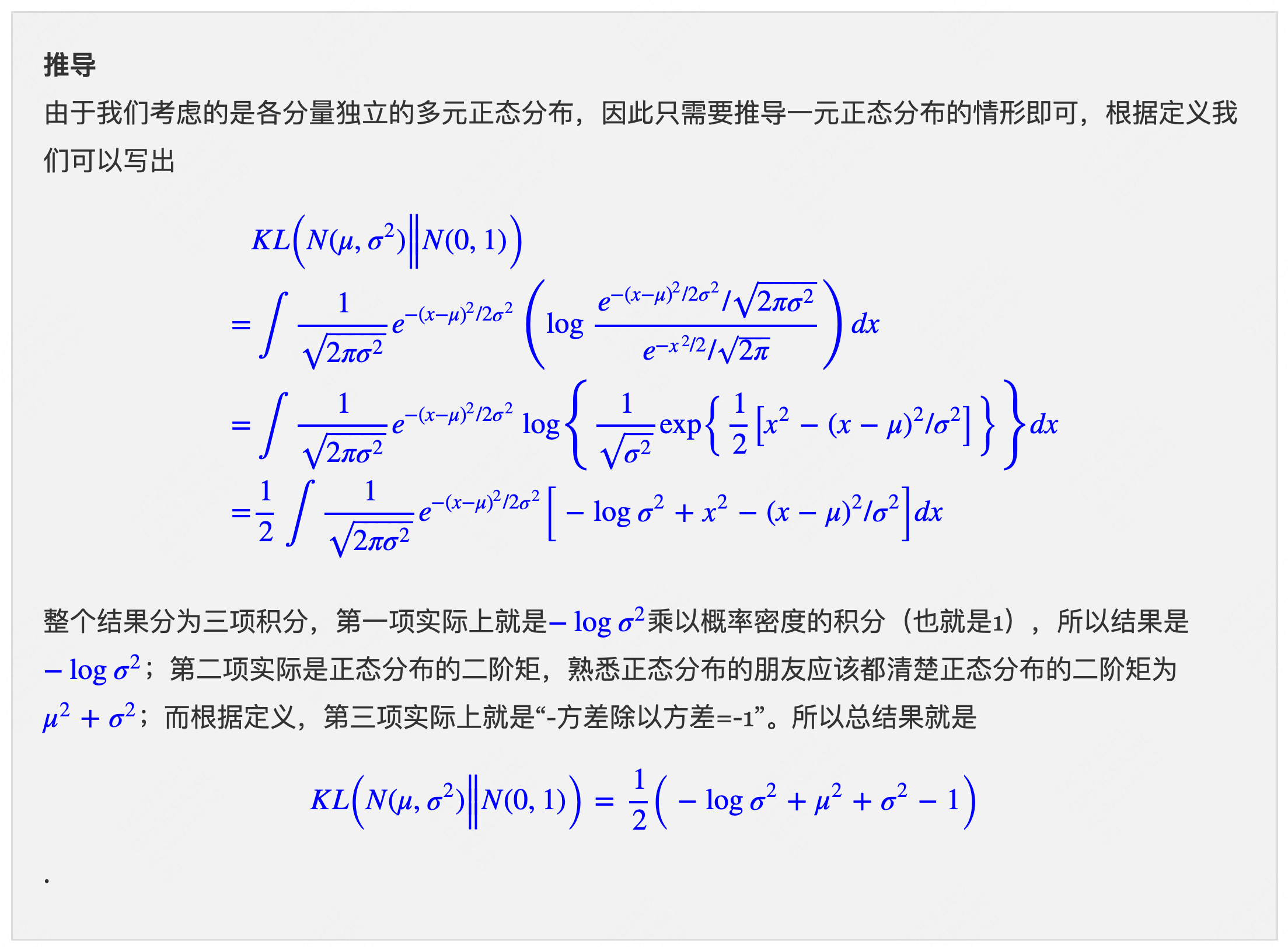
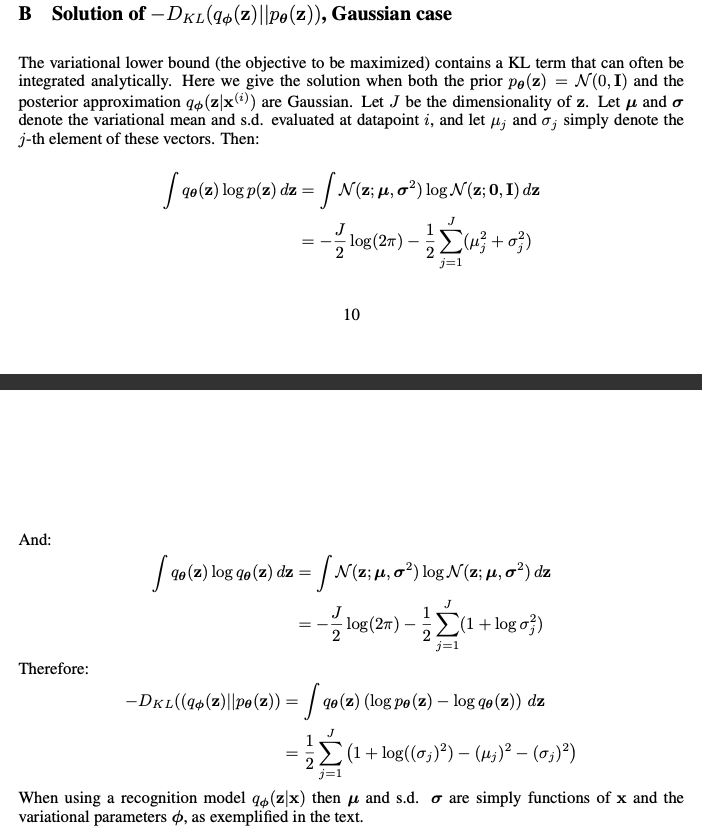
- 假设 \(p(z)\) 是均值为0方差为1的标准正太分布 \(N(0,I)\),所以这里KL散度本质是要尽量保证分布 \(q(z|x)\) 尽可能接近标准正太分布,使用一个关于均值和方差的损失函数可以实现
- KL散度部分的闭市解推导,来自 苏神的科学空间:
- 原始论文推导可见:Auto-Encoding Variational Bayes:
附录:ELBO的各种等价形式
- 一些等价形式:一些推导中会涉及到ELBO的不同形式:
$$
\begin{align}
\mathcal{L}(\theta, \phi; \mathbf{x}) &= \mathbb{E}_{q_\phi(\mathbf{z}|\mathbf{x})} \left[ \log p_\theta(\mathbf{x}|\mathbf{z}) \right] - D_{\text{KL} }\left(q_\phi(\mathbf{z}|\mathbf{x}) | p(\mathbf{z})\right) \\
&= \mathbb{E}_{q_\phi(\mathbf{z}|\mathbf{x})} \left[ \log p_\theta(\mathbf{x}|\mathbf{z}) \right] - \mathbb{E}_{q_\phi(\mathbf{z}|\mathbf{x})}\left[\frac{\log q_\phi(\mathbf{z}|\mathbf{x})}{\log p(\mathbf{z})}\right] \\
&= \mathbb{E}_{q_\phi(\mathbf{z}|\mathbf{x})} \left[ \log p_\theta(\mathbf{x}|\mathbf{z}) \frac{\log p(\mathbf{z})}{\log q_\phi(\mathbf{z}|\mathbf{x})}\right] \\
&= \mathbb{E}_{q_\phi(\mathbf{z}|\mathbf{x})} \left[ \log p_\theta(\mathbf{x}|\mathbf{z}) \frac{\log p(\mathbf{z})}{\log q_\phi(\mathbf{z}|\mathbf{x})}\right] \\
&= \mathbb{E}_{q_\phi(\mathbf{z}|\mathbf{x})} \left[ \frac{\log p_\theta(\mathbf{x},\mathbf{z})}{\log q_\phi(\mathbf{z}|\mathbf{x})}\right] \\
\end{align}
$$