注:本文包含 AI 辅助创作
- 参考链接:
Paper Summary
- 论文总结:
- 论文介绍了一种基于推理链的自动 Rule 提取机制(AutoRule),用于在语言模型对齐中利用 Rule-based 奖励
- 作者表明从 AutoRule 提取的 Rule 与偏好数据集有良好的一致性,并且在指令遵循基准的模型评估中提供了性能提升,且证明了 Rule-based 奖励方法在一定程度上缓解了奖励模型的过优化
- 论文的 Rule 信号只是作为辅助信号和标准 RL 一起训练的,并不是单独训练
- AutoRule 的核心是 “偏好数据 -> 推理链 -> 规则提取 -> 规则奖励 -> RL 优化” 的端到端流程
- 注:论文附录中提供了 UltraFeedback、MT-Bench 数据集提取的完整规则(如 UltraFeedback 规则含“翻译需保留原语气”“代码需无错误”等)
- 通过三步自动化流程从偏好数据中生成统一规则集,核心依赖具备推理能力的 LLM(如 Deepseek-R1):
- 推理生成 :给定偏好数据集中的“候选响应对+偏好标签”(如“响应A被拒绝,响应B被选中”),Prompt 推理型 LLM 生成分步推理链 ,解释为何选中的响应更优(考虑清晰度、连贯性、实用性等维度)
- 规则抽取 :从每条推理链中提取明确的“规则类陈述”(需可客观判断),例如“响应应避免冗余,聚焦核心查询”
- 规则合并 :聚合所有候选规则,通过LLM去除重复、合并语义相似规则,最终得到精简的统一规则集(通常压缩至原规模的 1-2%,提升计算效率)
- 注:本人亲自尝试过,在实际使用时,论文的 Rule 对于 RewardBench 等 Reward Model Benchmarks 的指标提升没有帮助(当然论文中作者也没有直接汇报 Reward Model Benchmarks 相关的指标,只是将 Rule 作为一个额外的信号加入到之前的 BT RM 中的)
- 论文之前的 Rule-based 方法通常依赖手动 Rule 工程
- AutoRule 是一种从偏好反馈中提取 Rule 并将其制定为 Rule-based 奖励的全自动化方法
- AutoRule 提取过程分为三个阶段:
- 利用推理模型来解释用户偏好
- 从这些解释的推理链中识别候选 Rule
- 将它们合成为一个统一的 Rule 集
- 利用最终确定的 Rule 集,采用语言模型 Verifier 来计算每个输出满足的 Rule 比例,在策略优化期间,将此度量作为辅助奖励与学习到的奖励模型一起使用
- 使用 AutoRule 训练 Llama-3-8B 模型,在 AlpacaEval2.0 上实现了长度控制胜率的 28.6% 相对提升,与使用相同学习奖励模型但未使用 Rule-based 辅助奖励训练的 GRPO 基线相比,在保留的 MT-Bench 子集上实现了第二轮性能 6.1% 的相对增益
- 实验证实:
- 提取的 Rule 与数据集偏好具有良好的一致性
- 在运行两个 episode 时,与学习到的奖励模型相比,AutoRule 表现出减少的 Reward Hacking
- Finally,论文的案例研究表明,提取的 Rule 捕获了不同数据集中看重的独特品质
- 提取的 Rule 在附录中提供
Introduction and Discussion
- RLHF 已成为使 LLM 与人类价值观对齐并增强其遵循人类指令能力的关键技术 (2022)
- RLHF 和相关的基于偏好的优化方法已被用于顶级行业模型,如 GPT-4 (2024)、Gemini (2025)、Claude (2024) 和 Llama 3 (2024)
- 基于 RL 的训练后方法也被用于增强 LLM 的推理能力
- Notably,DeepSeek-R1 发布的一个关键进步是采用了 Rule-based 奖励来确保准确性和格式,以替代神经奖励,作为缓解 Reward Hacking 的策略 (2025)
- 用于推理任务的 Rule-based 奖励特别有效,因为它们提供了控制策略行为的客观、可验证的标准
- 当语言模型的输出满足这些 Rule 时,它可以被可靠地认为是准确的 Response
- 虽然 Rule-based 奖励在推理任务上效果很好,但将它们用于语言模型的偏好对齐仍然具有挑战性
- 与代码或数学等领域不同,在那些领域可以构建明确的 Rule-based Verifier ,偏好对齐之所以困难,是因为人类偏好常常模糊且主观
- 现有的行业方法通常依赖于专家设计的 Rule (2022, 2024) 或大规模众包标注 (2022),这可能成本高昂且难以扩展
- 为了克服这些限制,论文引入了一个自动 Rule 提取框(AutoRule)
- AutoRule 利用先进 LLM 的推理能力直接从偏好数据中推导对齐 Rule
- 论文的方法从模型生成的推理链中提取明确 Rule ,超越了对人工设计或众包 Rule 的依赖
- 在 RL 训练期间,一个 LLM-as-a-judge (2023) Verifier 评估每个候选 Response 是否符合提取的 Rule ,生成的 Rule 分数被聚合以形成 Rule-based 复合奖励
- 然后,此奖励与标准模型奖励结合以指导策略优化
- 为了提取 Rule ,AutoRule 遵循以下流程
- 给定一对模型输出和一个相关的偏好标签:
- 首先 Prompt 一个具备推理能力的 LLM 为首选的输出生成一个逐步的理由
- 然后要求该 LLM 从其推理过程中提取明确的、类似 Rule 的陈述
- 这些候选 Rule 在训练集中进行聚合,之后 LLM 会合成一个统一的 Rule 集
- 论文 hypothesize,利用推理链的逻辑结构能够提取更精确和可操作的 Rule ,从而更好地捕捉潜在的偏好标准
- 给定一对模型输出和一个相关的偏好标签:
- 论文通过全面的实验经验性地验证了论文的方法
- First,论文展示了使用 Llama 3 8B Instruct (2024) 作为 Verifier 计算的 Rule-based 分数(无论是单独还是累积计算)在 UltraFeedback (2024) 和 MT-Bench Human Judgment (2023) 数据集上都与偏好有良好的一致性
- Next,论文使用标准的 RLHF 流程在 UltraFeedback 数据上对基础 Llama-3-8B 模型进行训练后,但用 GRPO (2024) 替换了传统的 PPO,并集成了 AutoRule 作为奖励机制
- 论文在多个基线上对论文的方法进行了基准测试,包括使用仅模型奖励的普通 PPO 和 GRPO,并在 UltraFeedback 胜率、AlpacaEval 2.0 和 MT-Bench 上进行评估
- 在所有三项评估中,AutoRule 始终优于基线
- Additionally, Reward Hacking 实验证明了 AutoRule Rule-based 奖励能够减轻奖励模型的过度优化
- 比较从推理链与仅从理由中提取 Rule 的消融研究支持了 AutoRule 中利用推理链的有效性
- Furthermore,定性分析表明,从 UltraFeedback 导出的 Rule 主要强调对话质量,而从 MT-Bench 提取的 Rule 则优先考虑指令遵循和在更复杂任务上的鲁棒性
- 总而言之,论文的主要贡献有三方面:
- 论文引入了 AutoRule,一个通过 LLM 生成的推理链从偏好数据中自动提取对齐 Rule 的框架
- 论文展示了通过 AutoRule 导出的 Rule-based 奖励,与标准的偏好优化基线相比,能带来改进的偏好对齐和指令遵循
- 论文证明了 AutoRule 能减少 Reward Hacking 并产生可解释的、适应数据集的 Rule
Methods
- 在本节中,论文概述 AutoRule 的自动 Rule 提取过程,演示如何利用这些 Rule 形成奖励分数,以及如何在 GRPO 公式中使用该奖励
- 图 1 提供了 Rule 提取和奖励计算流程的概述
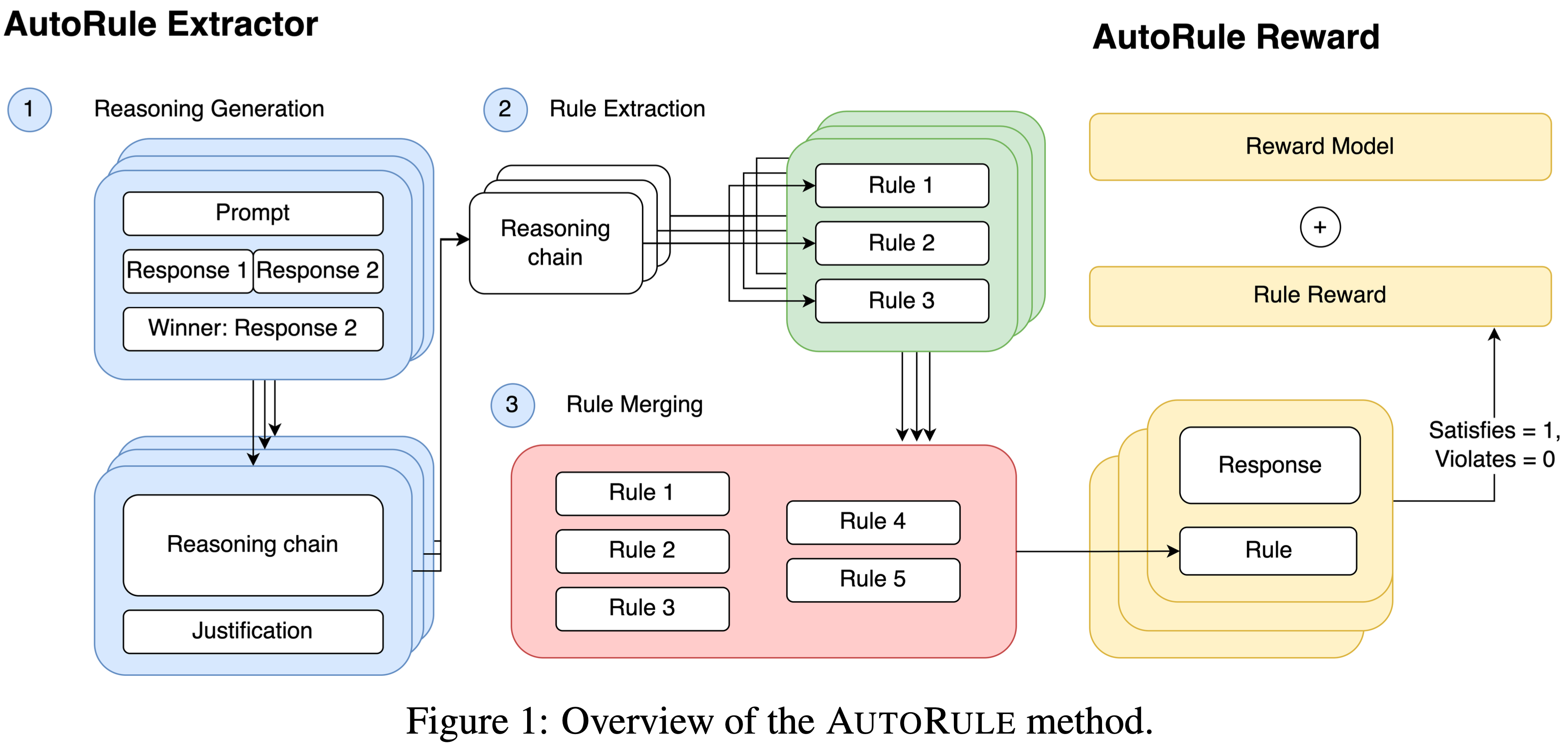
AutoRule Extractor
- 论文将语言模型表示为 \(\pi_{\theta}\),其中 Prompt \(x\) 作为状态
- 下一个 token \(t\) 作为动作,即 \(t \sim \pi_{\theta}(\cdot | x)\)
- 在 \(N\) 个 token 上展开此过程,生成输出序列 \(y = (y_{1},\ldots ,y_{N})\) 的概率由 \(\pi_{\theta}(y\mid x) = \prod_{i = 1}^{N}\pi_{\theta}(y_{i}\mid y_{< i},x)\) 给出
- 为简洁起见,论文将采样输出写为 \(y\sim \pi_{\theta}(\cdot \mid x)\)
- AutoRule 中的自动 Rule 提取过程包括三个主要阶段,每个阶段都利用一个推理语言模型 \(\pi_{\phi}\),该模型将 Response \(y\) 分解为输出 \(o\) 和相关的推理轨迹 \(r\),即 \((o,r)\sim \pi_{\phi}(\cdot \mid x)\)
Reasoning Generation
- 为了引导推理模型产生适用于 Rule 提取的连贯、逐步推理链,论文 Prompt 其说明为何 Chosen Response 更优
- 给定一个偏好数据集
$$\mathcal{D}_{\mathrm{pref} } = \left\{(x^{(1)},y_{c}^{(1)},y_{r}^{(1)}),\ldots ,(x^{(N)},y_{c}^{(N)},y_{r}^{(N)})\right\}$$ - 论文向推理模型呈现 \(x_{1} = \mathrm{prompt}(x,y_{c},y_{r},1)\) 或 \(x_{2} = \mathrm{prompt}(x,y_{r},y_{c},2)\),随机选择以变化候选顺序
- 每个 Prompt 都要求提供模型输出的理由
- 对于每个样本 \(i\),论文从模型生成 \((o^{(i)},r^{(i)})\sim \pi_{\phi}(\cdot \mid x)\) 中提取推理轨迹 \(r^{(i)}\),从而得到推理链的集合 \(RC = \{r^{(1)},\ldots ,r^{(N)}\}\)
- 此步骤以及后续步骤使用的 Prompt 显示在附录 F 中
Rule Extraction
- 接下来,论文从每个单独的推理链中提取明确 Rule
- 对于每个推理链 \(r^{(i)}\in RC\),论文使用 \(x = \mathrm{prompt}(r^{(i)})\) Prompt 推理模型,以引出证明偏好合理性的潜在 Rule
- 模型为每个 \(r^{(i)}\) 输出一组 Rule \(R^{(i)}\),即 \(R^{(i)},r\sim \pi_{\phi}(\cdot \mid x)\)
- 论文将这些 Rule 在所有样本上聚合以获得整体 Rule 集:
$$RS = \bigcup_{i = 1}^{N}R^{(i)}$$ - 通过这种方式利用推理模型,论文的目标是系统地将复杂的推理轨迹分解为精确、可操作的 Rule
- 从每个推理链单独提取 Rule 也简化了模型的任务,这应能促进更高质量和更可解释的 Rule 集
Rule Merging
- 鉴于从训练集中提取了大量 Rule ,合并 Rule 对于确保训练期间的计算效率至关重要
- 为了解决冗余和重叠问题,论文 Prompt 推理模型合并 Rule
- 为此,论文在 Prompt 中指出提供的 Rule 可能存在重复或语义相似的 Rule
- 然后,论文指示模型识别并合并 \(RS\) 中的 Rule ,以便没有重复或相似的 Rule 保留
- 这产生了一组精炼且紧凑的合并 Rule :
$$MR,r\sim \pi_{\phi}(\cdot |\mathrm{prompt}(RS))$$- 其中 \(MR\) 表示最终的合并 Rule 集
- 经验上,此合并过程大大减少了冗余,通常将 Rule 集压缩到其原始大小的 \(1-2\%\)
- 这显著提高了 Rule-based 奖励计算过程的效率
AutoRule Reward
- 为了构建用于 RL 目标的 Rule-based 奖励,论文采用 LLM-as-a-judge Verifier ,记作 \(V_{\theta}\)
- 给定一个 Prompt \(x\)、一个 Response \(y\) 和每个提取的 Rule \(c\in MR\), Verifier 提供一个 Rule 分数
$$ s_{i}\sim V_{\theta}(\cdot |\mathrm{prompt}(x,y,\mathrm{rule}_{i})) $$- 论文将 Rule 分数约束为二进制值,\(s_{i}\in \{0,1\}\)
- AutoRule 奖励 \(r_{RA}\) 定义为在所有 \(K = |MR|\) 条 Rule 上的平均 Rule 满足度:
$$r_{RA}(x,y) = \frac{1}{K}\sum_{i = 1}^{K}s_{i}$$- 其中每个 \(s_{i}\) 如上所述获得
- 理解:这里是直接将分数累加,在指令遵循种可能会导致模型可以避开一些特别难遵循的结果
- 用于训练的最终奖励将 Rule-based 奖励 \(r_{RA}\) 与标准奖励模型分数 \(r_{\theta}\) 和 KL 惩罚相结合(精确的 KL 惩罚公式见附录 B.3):
$$r_{\mathrm{total} }(x,y) = r_{RA}(x,y) + r_{\theta}(x,y) - \beta_{KL}KL_{\mathrm{approx} }$$- GRPO 中都不是加在奖励上,这里为什么要加在奖励上?
- 与分配连续分数以反映细微偏好差异的传统奖励模型不同,论文的 Verifier \(V_{\theta}\) 的任务仅是确定每条 Rule 是否被满足,产生二元结果
- 这种简化降低了奖励建模过程的复杂性,使 Verifier 不易受到错误判断的影响,减轻了 Reward Hacking 的风险
AutoRule RL Stage
- AutoRule 使用 GRPO 算法 (2024) 进行偏好对齐的强化学习阶段,使用 \(r_{\mathrm{total} }\) 作为奖励信号(Rule-based 奖励 \(r_{RA}\) 与标准奖励模型分数 \(r_{\theta}\) 和 KL 惩罚相结合)
- GRPO 是一种策略优化算法,它使用一组输出的相对奖励来确定优势估计,消除了传统 PPO (2017) 中使用的单独价值模型的需求,提高了内存和计算效率
- 形式上,GRPO 利用一组输出并计算它们的奖励,将其合并为一个奖励向量 \(\mathbf{r} = \{r_{1},\ldots ,r_{n}\}\)
- GRPO 为特定输出 \(i\) 计算优势估计:
$$\hat{A}_i = \frac{r_i - \mathrm{mean}(\mathbf{r})}{\mathrm{std}(\mathbf{r})}$$ - 此优势估计用于以下裁剪代理目标 (2017):
$$L(w) = \mathbb{E}_{(x,y)\sim \mathcal{D}_{val} }\left[\min \left(\frac{\pi_w(y\mid x)}{\pi_{val}(y\mid x)}\hat{A},\mathrm{clip}\left(\frac{\pi_w(y\mid x)}{\pi_{val}(y\mid x)},1 - \epsilon ,1 + \epsilon\right)\hat{A}\right)\right]$$- 其中 \(\epsilon\) 是一个裁剪超参数,\(\frac{\pi_w(y\mid x)}{\pi_{val}(y\mid x)}\) 是似然比
- In Summary
- AutoRule 引入了一个自动化的、基于推理链的 Rule 提取框架,可以生成精确且可操作的对齐 Rule ,从而消除了手动 Rule 工程的需要
- 通过利用提供二进制 Rule 满足判断的 LLM-as-a-judge Verifier ,论文的方法与传统的连续奖励模型相比简化了奖励建模,有助于减轻 Reward Hacking 并增强偏好对齐的可靠性
Experimental Methodology
Dataset
- 论文使用 UltraFeedback-Binarized 数据集(简称 UltraFeedback),它是 UltraFeedback (2024) 的二值化版本,包含来自不同模型类型和指令的近 64K 条成对偏好标注
- For Training,论文筛选了 33K 个示例的子集(详情见附录 B.6)
- 论文还使用了 MT-Bench 人工判断数据集(简称 MT-Bench)(2023),该数据集提供了多轮问题的专家偏好标注
Evaluation Metrics
- 论文在 UltraFeedback-Binarized 测试集上报告胜率,使用 GPT-4o 作为自动评判器,并随机化候选和参考 Response 的顺序
- 论文还在 MT-Bench(使用 GPT-4 作为评判器)和 AlpacaEval 2.0 (2024) 上进行了评估
- 对于 AutoRule,AlpacaEval 2.0 和 UltraFeedback 胜率是在使用 UltraFeedback Rule 训练的模型上测量的
- 对于 MT-Bench,论文将 80 个问题分为 40 个用于训练 AutoRule,40 个用于测试(每个 Split 每个类别 5 个)
Rule Extraction
- 论文使用 Deepseek-R1 (2025) 来生成用于自动 Rule 提取的推理链
- 对于 LLM-as-a-judge Verifier
- 论文使用 Llama-3-8B-Instruct (2024) 以在计算效率上优于更大的 Deepseek-R1 模型
- 理解:这里,若 Rule 不够简单的话,Llama-3-8B-Instruct 的性能应该是远远不够的
- 为了提取 Rule
- 论文从 UltraFeedback 训练 Split 中随机抽取 256 个示例;
- 对于 MT-Bench,论文使用 40 个问题的训练 Split ,并为训练每个问题采样最多 8 个示例,如果可用数量更少则使用全部
Baselines
- 论文与多个基线进行比较:
- (1) 使用 PPO 的 RLHF(“RLHF”)
- (2) 使用基础奖励且无超参数调优的 GRPO(“GRPO”)
- (3) 带长度惩罚的 GRPO(“GRPO + Length Penalty”,简写为 LP)
- (4) 带 length-driven 超参数调优的 GRPO(“GRPO + Length Control”,简写为 LC)
- 问题:这里的 GRPO+LC 是指特意针对长度惩罚调整过超参数的
- 所有基线均使用相同的学习奖励模型
AutoRule Model
- 对于 AutoRule,论文使用一个经过缩放的 Rule-based 奖励 \(r_{RA}\):
$$r_{RA^{\prime} } = \alpha r_{RA} + \beta$$- 其中 \(\alpha = 10\) 且 \(\beta = - 7.5\),以使 Rule-based 奖励幅度与学习奖励模型对齐,实现稳定训练
- Verifier Prompt 被修改为只有当 Response 简洁且完全满足提取的 Rule 时,\(s_i = 1\)
Implementation Details
- 所有模型都从相同的 SFT 和奖励模型检查点初始化以确保可比性
- 这里的 SFT 检查点是通过在筛选后的 UltraFeedback-Binarized 数据集的偏好 Response 上微调 Llama-3-8B 获得的
- 奖励模型从这个 SFT 检查点初始化,并在筛选后的 UltraFeedback-Binarized 训练 Split 的偏好标注上进一步微调
- Actor、Critic 和值网络(如适用)均从 SFT 检查点初始化
- 训练使用 OpenRLHF (2024),这是一个开源的 RLHF 框架
- 超参数和更多细节在附录 B 中,资源链接可在附录 H 中找到
Evaluation Results
- 在本节中,论文将在 Rule 质量、模型性能和 Reward Hacking 缓解方面评估 AutoRule
- 然后论文将分析 AutoRule 的几个消融研究以及提取 Rule 的案例研究
Rule quality
- 所有提取的 Rule 均在附录 C 中展示
- 论文在 1,024 个 UltraFeedback 测试示例和完整的 MT-Bench 人工判断 Split 上评估 Rule 一致性
- 对于单个 Rule ,一致性以 Rule 偏好与真实标注相匹配的 Response 对比例来衡量,仅考虑 Rule 能区分 Response 的对
- 论文还报告了聚合 Rule 奖励增量(Chosen 奖励与 Rejected 奖励之差)的分布
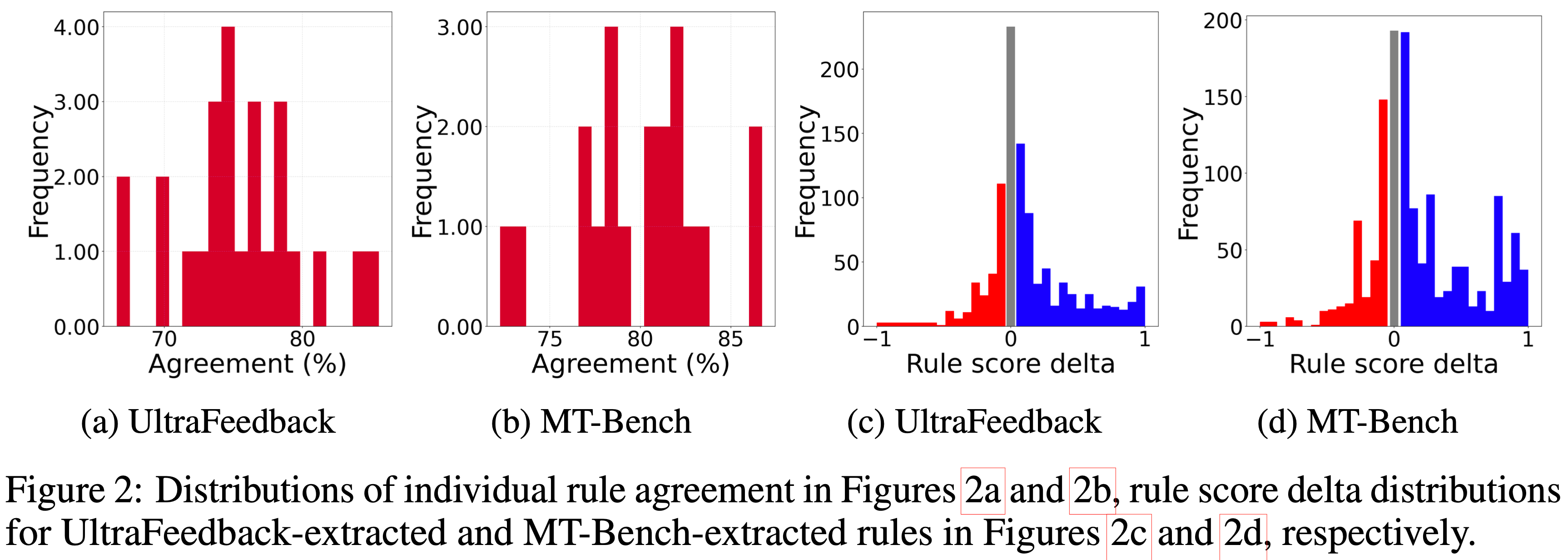
- 图 2a 和 2b 展示了单个 Rule 一致性的分布
- 论文观察到,来自两个 Rule 集的单个 Rule 都与数据集中真实的偏好有良好的一致性
- 此外,与 MT-Bench Rule 的平均一致性超过了与 UltraFeedback Rule 的平均一致性,这表明在人工标注数据上自动 Rule 提取似乎比在 LLM 生成的偏好数据上更有效
- 图 2c 和 2d 展示了 Rule 分数增量的分布
- Rule 分数增量的分布在正侧呈现更重的尾部,表明更多的 Chosen Response 获得了更高的分数
- 随着增量幅度的增加,正尾变得更重,这意味着更大的增量幅度与更可靠的偏好对齐相关
- 图 2a 和 2b 展示了单个 Rule 一致性的分布
- 除了 Rule 一致性,论文还进行了一个小实验来评估 Rule 的确定性
- 方法是在 UltraFeedback Rule 集上对 20 个 UltraFeedback 测试集 Response 运行 100 次温度为 1.0 的 Verifier 推理,并在 MT-Bench Rule 集上对 16 个 MT-Bench 测试集 Response 进行同样的操作
- 使用确定性分数计算公式 \((\max (\# \mathrm{Yes}, \# \mathrm{No}) / (\# \mathrm{Yes} + \# \mathrm{No}))\)(其中 Yes/No 表示 Rule 满足情况的答案),论文为 UltraFeedback 和 MT-Bench 提取的 Rule 分别获得了平均 \(83.6%\) 和 \(82.5%\) 的确定性分数
- 这些结果表明 Rule 具有很高的一致性,并且 Verifier 提供了可靠的判断,支持它们适用于奖励制定
Model Performance
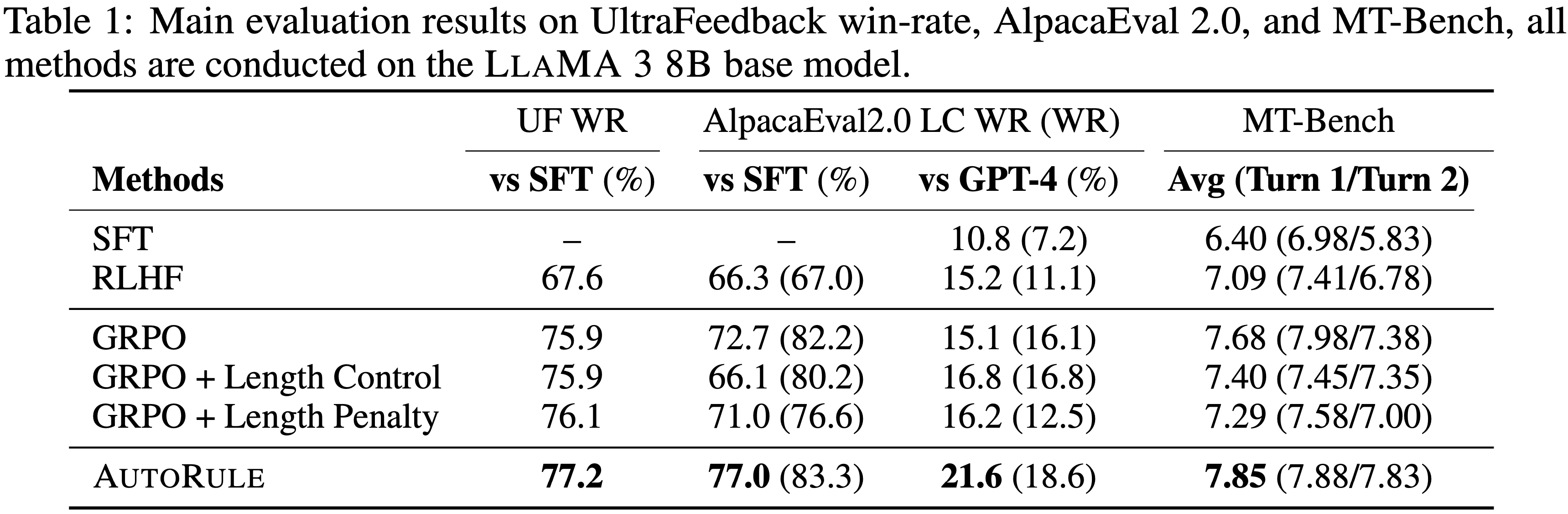
- 表 1 展示了基线和 AutoRule 模型在多个评估指标上的综合比较,包括 UltraFeedback 胜率、AlpacaEval 2.0 长度控制胜率 (LC WR)/常规胜率 (WR) 以及 MT-Bench 性能
- 问题:这里都是百分比涨幅,那么实际上的分数绝对值涨幅应该会低很多吧?效果似乎不是很显著?
- 问题:这里都是百分比涨幅,那么实际上的分数绝对值涨幅应该会低很多吧?效果似乎不是很显著?
- 论文的结果表明, Rule-based 奖励模型在各自训练领域中都是有效的
- 具体来说,当使用从 UltraFeedback 提取的 Rule 进行训练时,AutoRule 在 UltraFeedback 胜率上相比基线获得了 \(1.7%\) 的相对提升,表明提取的 Rule 成功捕捉了该数据集中人类偏好的重要方面
- 对于 MT-Bench,论文使用从 40 个精心挑选的多轮 Prompt 子集推导出的 Rule 来评估 AutoRule
- 值得注意的是,与基线相比,该模型在第二轮性能上表现出 \(6.1%\) 的相对增益,证明了 Rule-based 监督对于复杂的多轮交互是有效的
- 除了领域内性能,论文的发现表明,相对于传统基线, Rule-based 方法在泛化到分布外任务方面表现更优
- 在 AlpacaEval 2.0 上,AutoRule 在长度控制胜率上相比 SFT 基线实现了 \(5.9%\) 的相对提升,相比 GPT-4 Turbo 实现了 \(28.6%\) 的提升,这凸显了 Rule-based 奖励在缓解长度偏见和提升实质性 Response 质量方面的鲁棒性
- 问题:相比 GPT-4 Turbo 实现了 \(28.6%\) 的提升 体现在哪里?是否写错了,应该是 5.4% 吧?
- 这些结果共同表明,AutoRule 不仅在训练分布内表现出色,还能有效迁移到多样化的评估环境中,优于标准的和减少长度偏见的基线
Reward Hacking Mitigation
- 为了系统评估 Reward Hacking ,论文在整个训练过程中监控模型性能,以检测任何表明对奖励信号过拟合的性能退化
- 论文进行了四次实验运行:三个基线和一次使用 UltraFeedback 推导出的 Rule 训练的 AutoRule 实例
- 每个运行两个训练周期(即,对数据集进行两次完整遍历)
- 模型每两步保存一次检查点
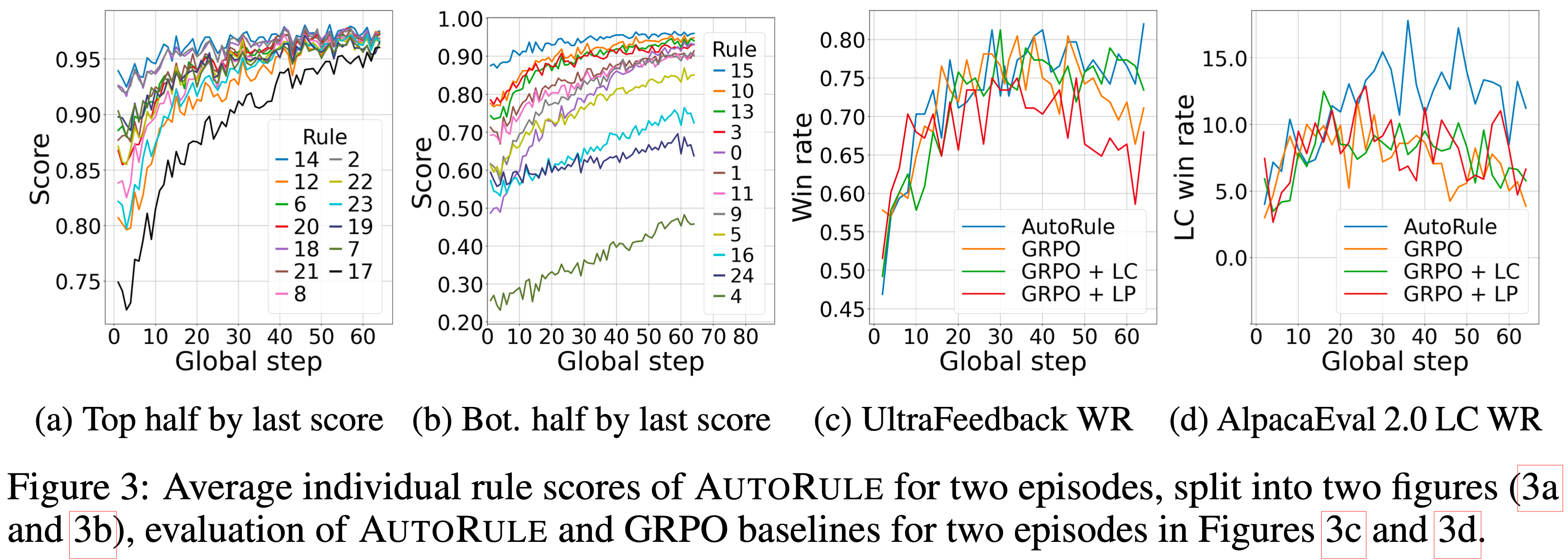
- 作为初步验证,论文在图 3a 和 3b 中报告了作为全局步数函数的平均单个 Rule 分数
- 观察到的所有 Rule 分数呈上升轨迹表明,模型正在有效地针对 Rule-based 奖励信号进行优化
- 这些结果验证了在 AutoRule 框架下将这些训练运行用于后续奖励动态分析的可行性
- 理解:每个 Rule 的分数在训练中都在逐步提升;3a 和 3b 中分别是不同的 Rule
- 对于每个检查点,论文评估相对于 SFT 检查点的 UltraFeedback 胜率,以及相对于 GPT-4 的 AlpacaEval 2.0 长度控制胜率(两者都仅使用 128 个示例的子集)
- 图 3c 描绘了 UltraFeedback 胜率随全局步数的变化
- 最初,基线和 AutoRule 模型取得了相似的胜率;
- 然而,在第 52 步之后,GRPO 和 GRPO + LP 基线的性能开始下降,而 GRPO + LC 和 AutoRule 则保持了持续的高胜率
- 图 3c 描绘了 UltraFeedback 胜率随全局步数的变化
- 对于分布外泛化,图 3d 展示了 AlpacaEval 2.0 胜率随全局步数的变化
- 在这里,AutoRule 持续优于所有 GRPO 基线,包括 GRPO + LC,在两个训练周期后取得了大约 5 个百分点的提升
- 虽然 GRPO + LC 缓解了在分布内数据上的 Reward Hacking ,但 Rule-based 奖励对于分布内和分布外设置都提供了对抗 Reward Hacking 的鲁棒性
Ablation Study
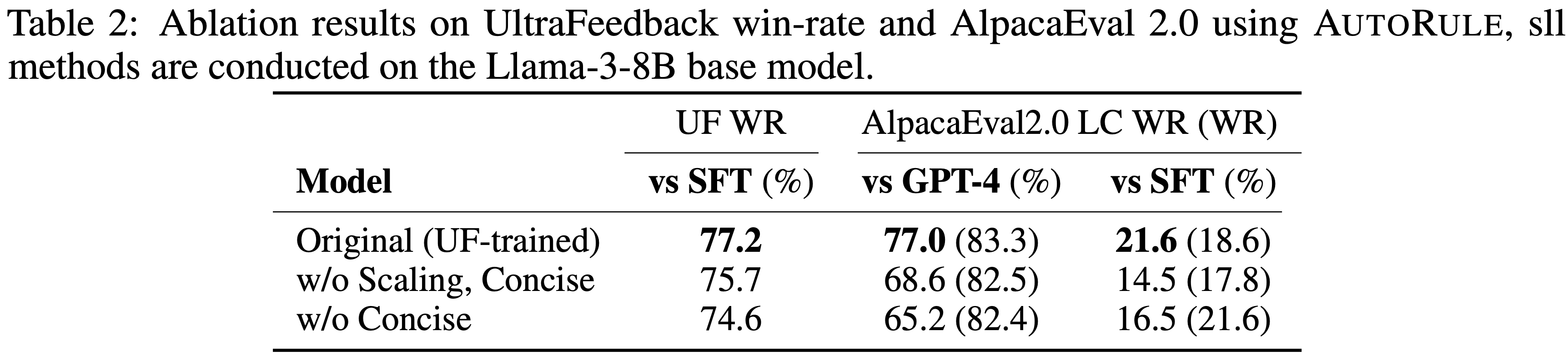
- 为了更好地理解论文框架中各个组件的贡献,论文进行了一项消融研究,重点关注两个关键方面:奖励缩放和简洁性约束
- 具体来说,论文考虑了以下变体:
- (1) 一个在没有 Rule-based 奖励缩放的情况下训练的模型,缩放参数设置为 \(\alpha = 1\),\(\beta = 0\)(标记为“w/o Scaling”)
- (2) 一个修改了 Verifier Prompt 以省略对简洁性引用的模型,从而移除了对简洁 Response 的显式指导,同时也没有缩放(标记为“w/o Scaling, Concise”)
- 表 2 中总结的结果表明,移除奖励缩放或简洁性指导中的任一项都会导致 UltraFeedback 胜率和 AlpacaEval 2.0 长度控制胜率持续下降
- 缺乏奖励缩放削弱了模型有效利用 Rule-based 监督的能力,而省略简洁性约束则导致 Response 与人类对简洁和清晰偏好的对齐度降低
- 这些发现强调了在 AutoRule 框架内同时进行 Rule 奖励缩放和明确鼓励简洁 Response 的重要性
Rule Analysis
Reasoning VS. Justification Rules
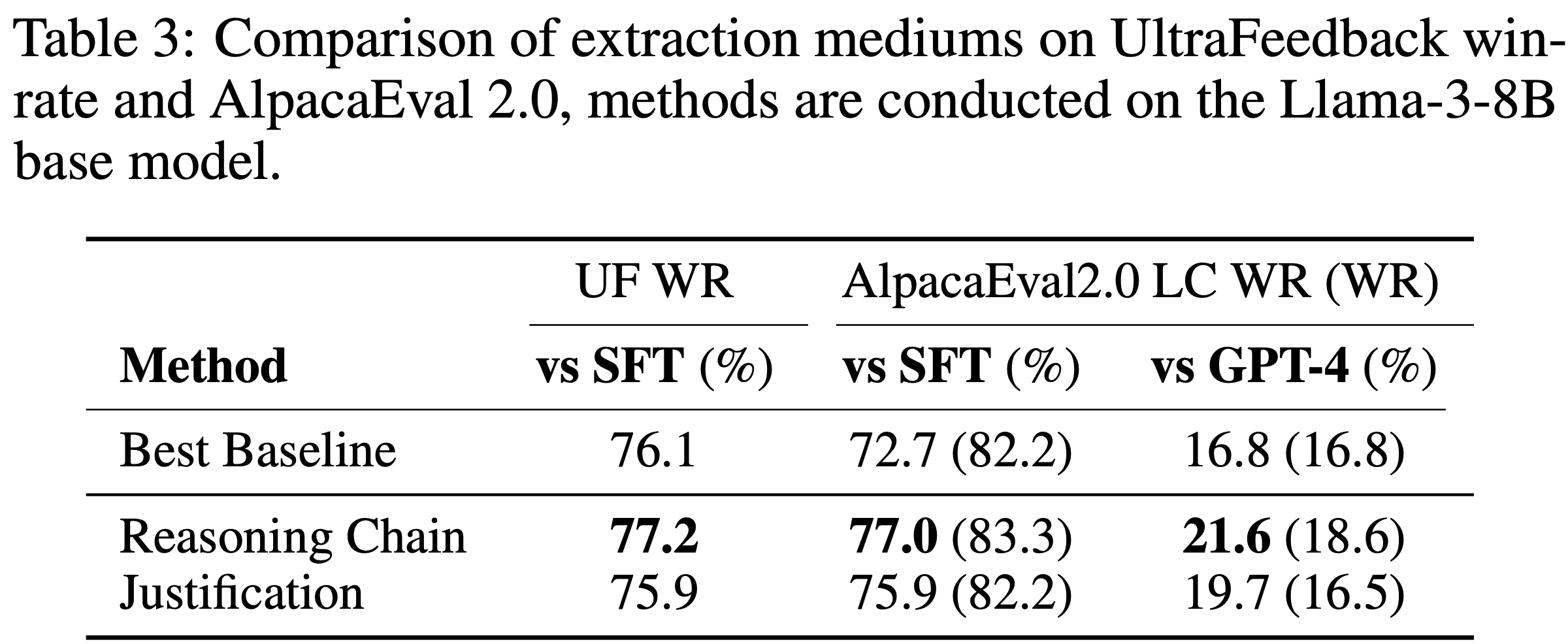
- 论文研究了提取媒介对 Rule 质量和下游性能的影响
- 具体来说,论文比较了直接从模型论证(Justifications,即思维链推理之后 Deepseek-R1 的直接输出)提取的 Rule 与从推理链提取的 Rule
- 表 3 报告了比较这两种提取媒介的模型性能结果
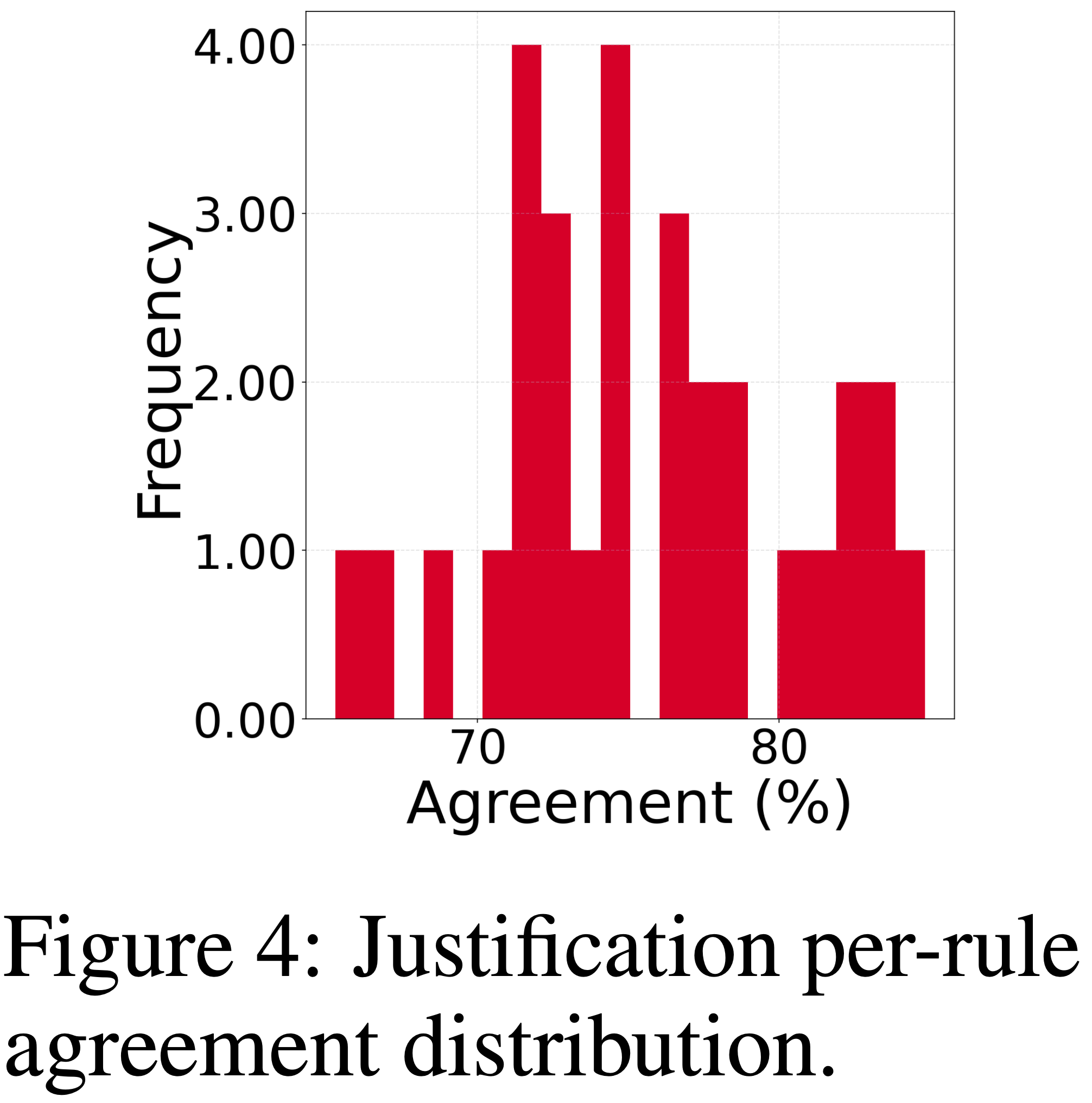
- 图 4 展示了模型论证的单个 Rule 一致性分布
- 虽然 Rule 一致性分布与推理链相似,但论文发现从推理链提取 Rule 仍然显著提高了 UltraFeedback 胜率和 AlpacaEval 2.0 长度控制胜率
- 这表明推理链包含了允许提取更好 Rule 的信息
- 论文推测这是因为推理链为 Rule 制定提供了更具体和可操作的指导,而论证往往不够详细且更泛化,导致下游性能下降,并通过附录 E 中的案例研究来论证这一点
Rule Agreements
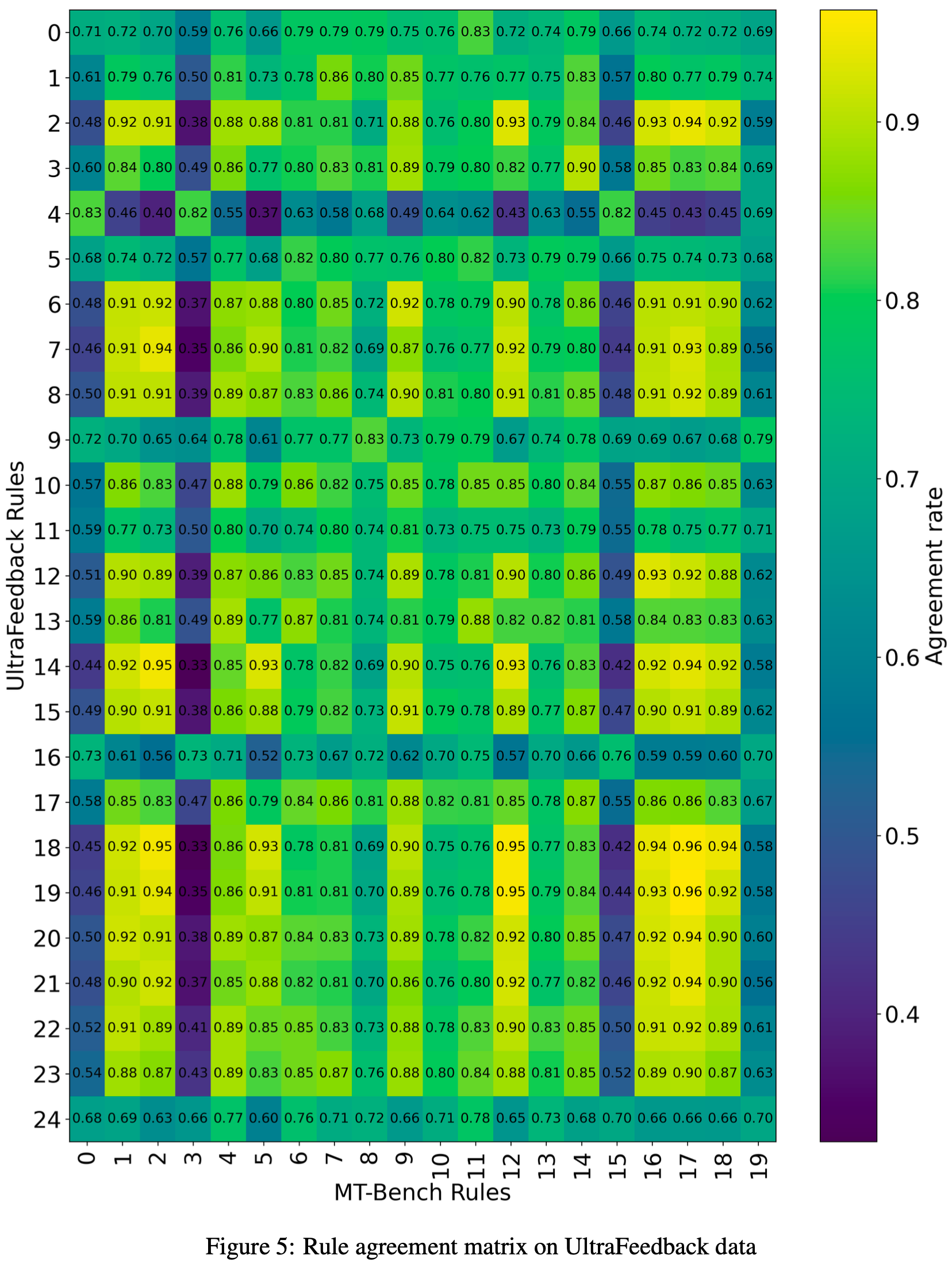
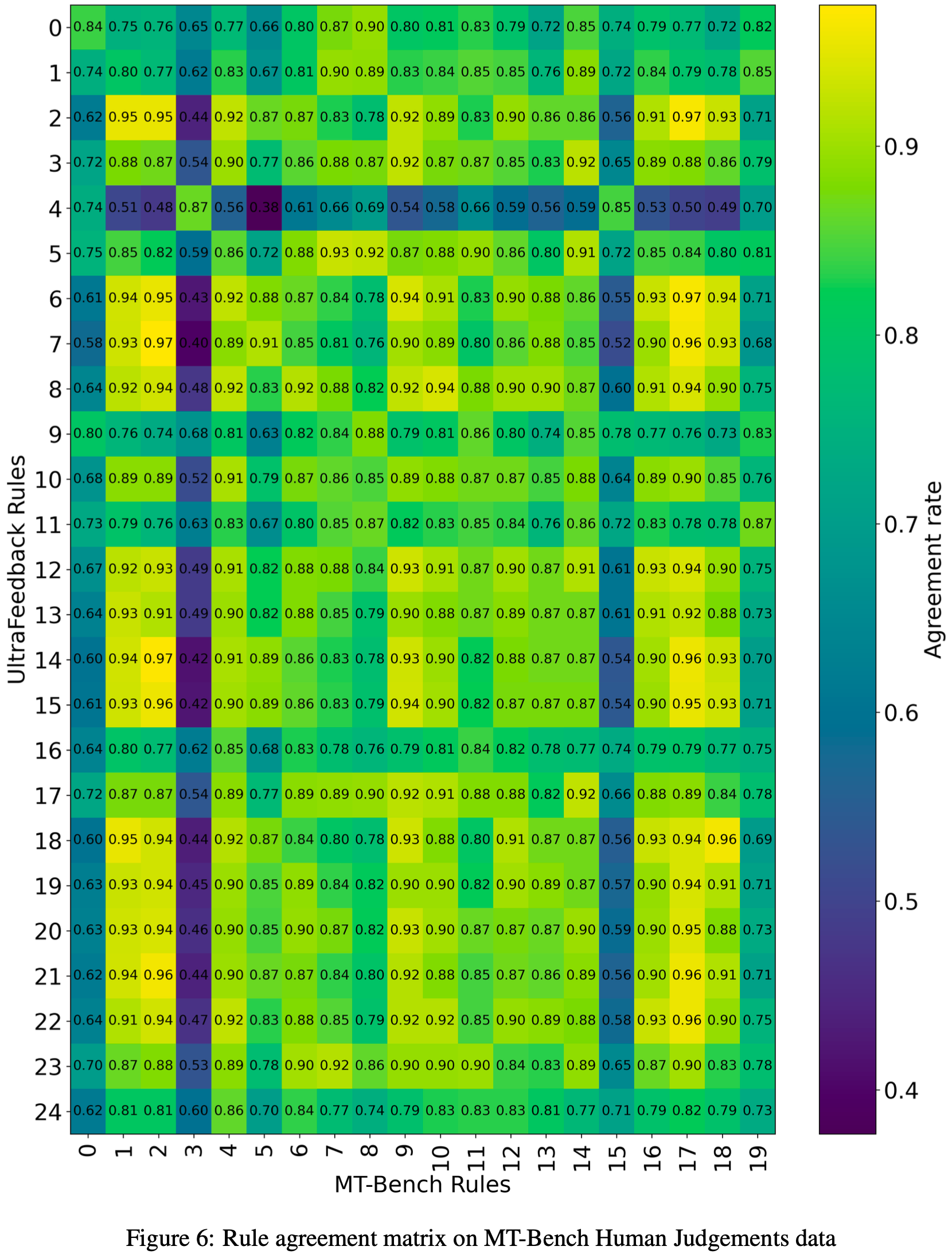
- 为了进一步研究 Rule 提取的有效性,论文对从 UltraFeedback 和 MT-Bench 推导的 Rule 集进行了比较分析
- 具体来说,论文通过在 1,024 个 UltraFeedback 示例和完整的 MT-Bench 人工判断测试 Split 上评估所有 Rule 对,构建了一个 Rule 一致性矩阵
- 基于此矩阵,论文根据一致性分数识别相似和独特的 Rule
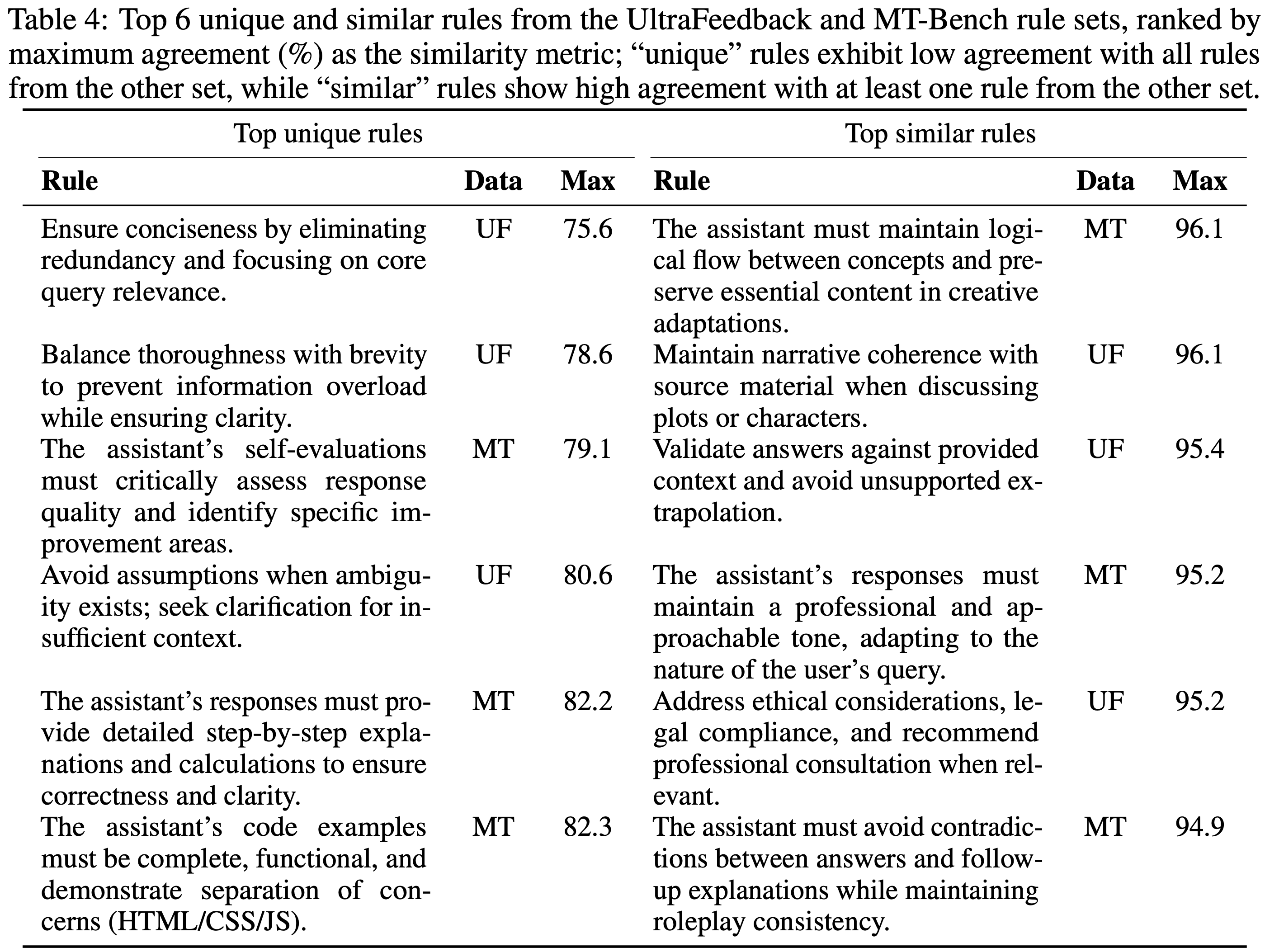
- 表 4 分别展示了按与对立 Rule 集在 UltraFeedback 和 MT-Bench 示例上的最大 Rule 一致性排序的前六个独特 Rule 和前六个相似 Rule
- 来自 UltraFeedback 的独特 Rule 似乎主要强调简洁性和清晰度,而来自 MT-Bench 的独特 Rule 则侧重于处理复杂任务,例如自我评估、执行计算或提供代码示例
- 这种区别可能反映了 UltraFeedback 更广泛的主题多样性和 MT-Bench Prompt 的专业性和挑战性
- 相比之下,两个集合之间共享的相似 Rule 始终涉及高质量助手 Response 的核心方面,包括逻辑连贯性、专业语气、上下文一致性以及答案一致性
- 完整的 Rule 一致性矩阵在附录 D 中提供以供进一步参考
补充:Related Work
- RLHF 是将 LLM 与人类偏好对齐的标准框架 (2022),RLHF 通常包括:
- (1) 在人工标注的 Response 上进行监督微调;
8 (2) 训练一个奖励模型来预测人类偏好; - (3) 强化学习,通常通过近端策略优化 (2017),使用奖励模型作为优化信号
- (1) 在人工标注的 Response 上进行监督微调;
- 最近的工作探索了 RL 阶段更高效的方法,例如直接偏好优化 (2023),它消除了奖励模型,以及组相对策略优化 (2024),它使用来自输出组的相对奖励
- 在使用学习到的奖励模型的 RLHF 中,一个有据可查的(Well-documented)挑战是 Reward Hacking (2022, 2023, 2023)
- 即模型利用奖励模型的特性获得高奖励,而并未真正改善 Response 质量
- For Example,Miao 等人 (2024) 发现奖励模型可能过拟合于浅层特征,如 Response 长度,这些特征并不能推广到人类偏好的真实分布
- 支持这一点的是,Singhal 等人 (2024) 表明,在 PPO 期间仅针对 Response 长度进行优化可以获得与使用学习到的奖励模型相当的性能,这表明奖励模型常常捕捉简单的启发式方法,而非 Response 质量中更细微的方面
- 已经提出了几种策略来减轻 Reward Hacking ,包括修改奖励模型架构和调整奖励缩放
- ODIN (2024) 增加了一个辅助长度预测头以”解耦”长度与其他特征
- 注:这个方法不错,其实值的参考,应该会有一定的收益
- 奖励塑造方法,如 PAR (2025) 和 LSC (2024),应用以参考模型输出或百分位数为中心的 sigmoid 或 log-sigmoid 变换
- 其他方法利用多个奖励模型:WARM (2024) 平均多个奖励模型的输出以减少过度优化,而 ArmoRM (2024) 使用门控机制组合可解释的奖励目标
- ODIN (2024) 增加了一个辅助长度预测头以”解耦”长度与其他特征
- 一种日益增长的减轻 Reward Hacking 的策略是采用 Rule-based 奖励目标,尤其是在大规模工业 LLM 部署中
- 例如,DeepSeek 在 DeepSeek-R1 (2025) 的训练后阶段使用了 Rule-based 奖励 ,明确优先考虑 Rule-based 标准而非学习到的奖励模型以减少 Reward Hacking
- 他们的方法包含两种奖励:
- 准确度奖励,评估 Response 是否正确并遵循指定格式;
- 格式奖励,鼓励模型在指定的”think”标签内呈现其推理链
- 理解:这里说的其实就是 DeepSeek-R1 中数学等场景所说的 RLVR,不是在开放领域的 Rubrics
- 在偏好优化领域,已有一些工作探索了 Rule-based 目标,但由于人类偏好的不透明性,识别合适的 Rule 具有挑战性
- Anthropic 的 Constitutional AI (2022) 使用了一套精心策划的宪法(Constitutional)原则来指导 Response 修订和偏好判断,但这些并未直接用作标量奖励
- DeepMind 的 Sparrow (2022) 采用研究人员设计的行为 Rule ,从人类评估者那里收集 Rule 违反标注来训练一个专门的 Rule 奖励模型
- 通过同时使用 Rule-based 和基于偏好的奖励优化策略,Sparrow 实现了 Rule 违反的减少
- OpenAI 也研究了用于安全对齐的 Rule-based 奖励,将策略 Rule 分解为简单命题,并使用它们作为拟合线性模型中的特征,在 RL 期间构建奖励信号 (2024)
- 尽管有用,但构建有效的 Rule 集成本高昂,需要重要的领域专业知识,并且通常需要针对具体场景进行定制
- 因此,偏好学习中的 Rule-based 方法在工业界仍然主要是专有的,学术研究中公开可用的 Rule 集很少
附录 A: Discussion
A.1 Limitations
- 虽然论文的方法在从 UltraFeedback 到 AlpacaEval 2.0 的泛化方面表现出良好的前景,但未来还需要进一步工作来评估 AutoRule 在更广泛任务和领域间的迁移能力
- 此外,建立一个形式化的理论框架,以更好地理解和改进像 AutoRule 这样的 Rule-based 方法缓解 reward hacking 的机制,仍然是未来研究的重要方向
Broader Impacts
- 这项工作有潜力通过缓解基于奖励模型的方法中常见的过优化和特质问题,推动开发更有帮助且更不易产生有害行为的对话智能体
- Rule-based 框架所提供的可解释性增强了透明度,使研究人员和从业者能够更好地理解和审视支配 LLM 的对齐机制
附录 B: Additional experiment details
B.1 Training settings
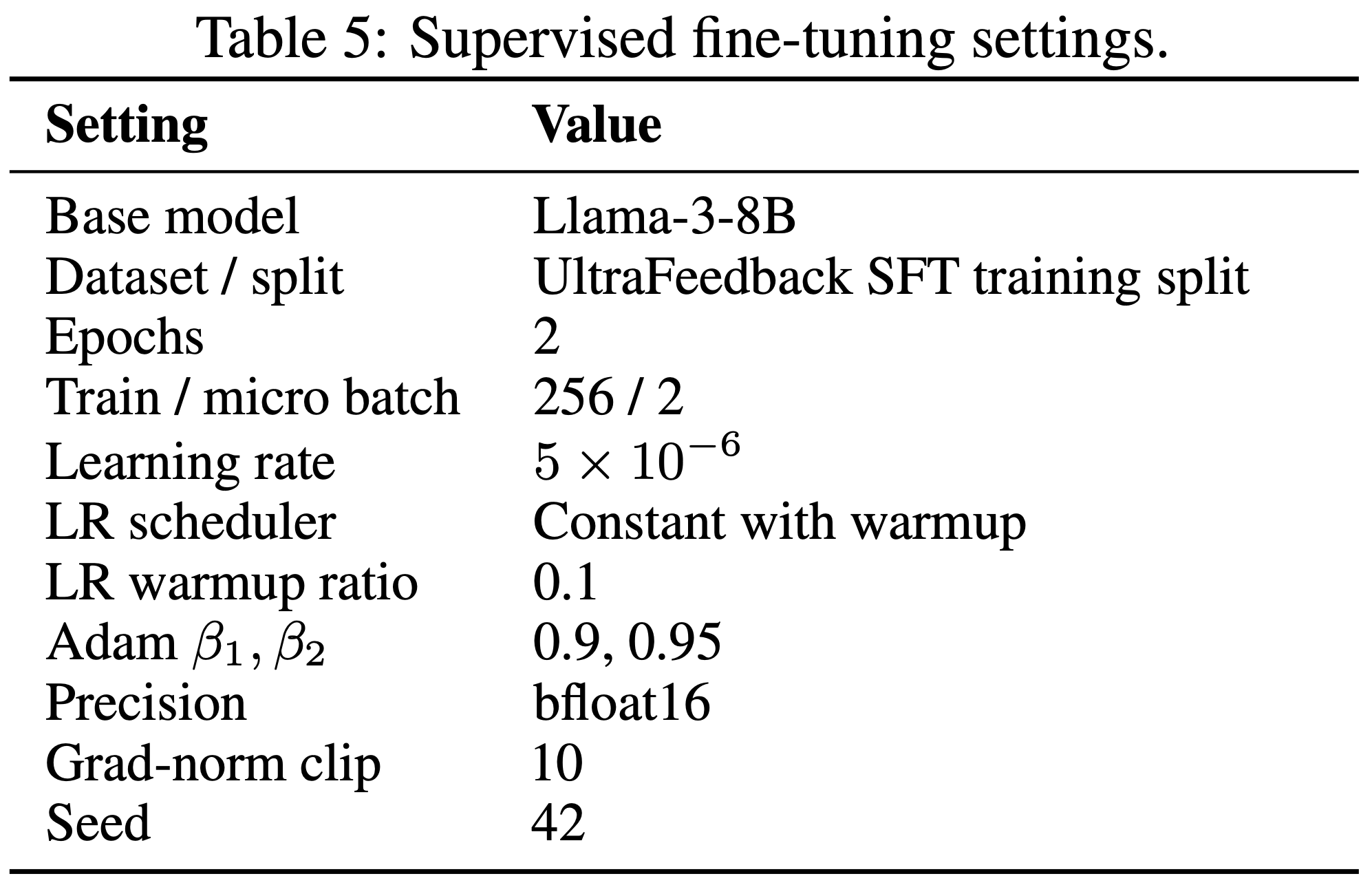
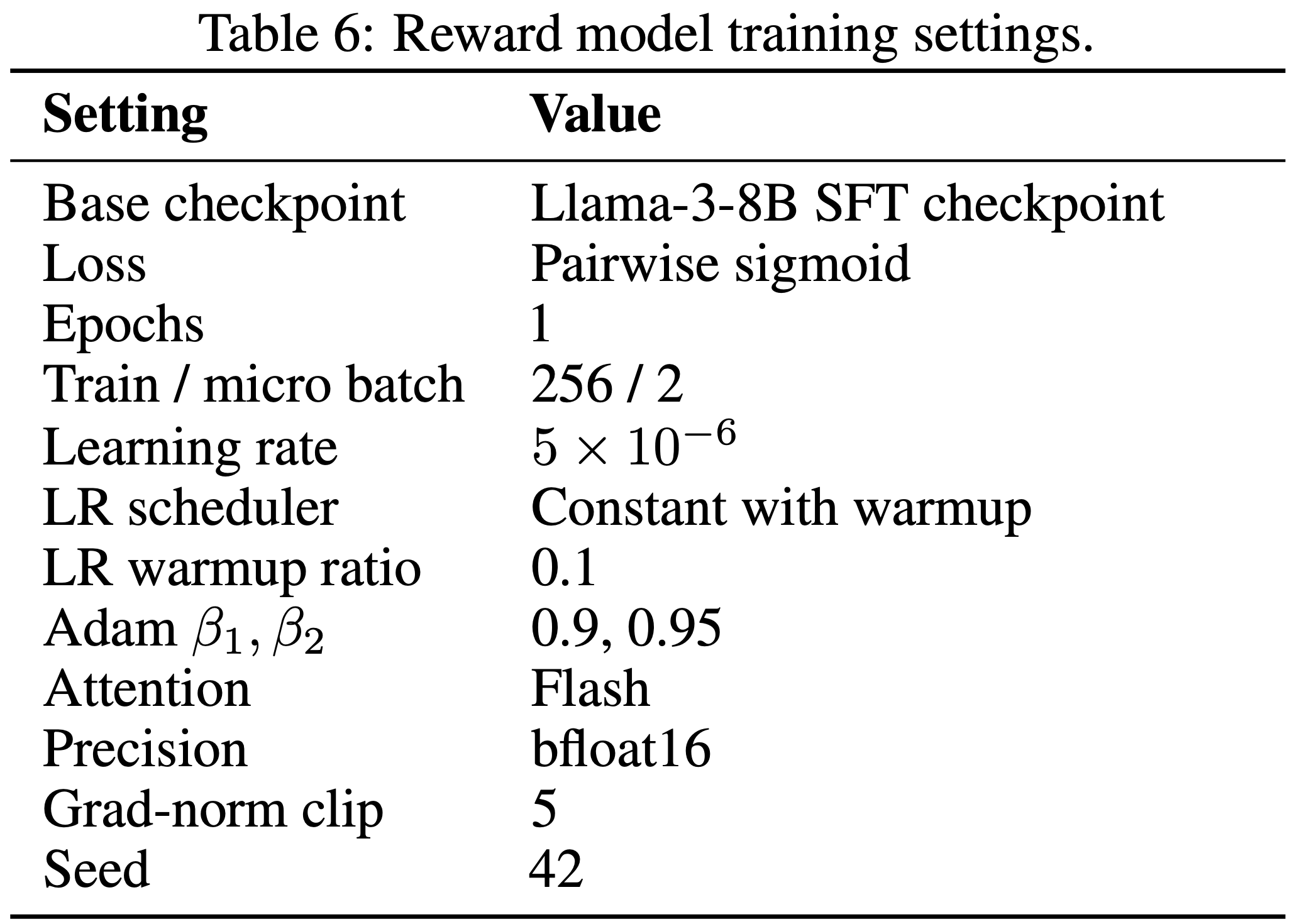
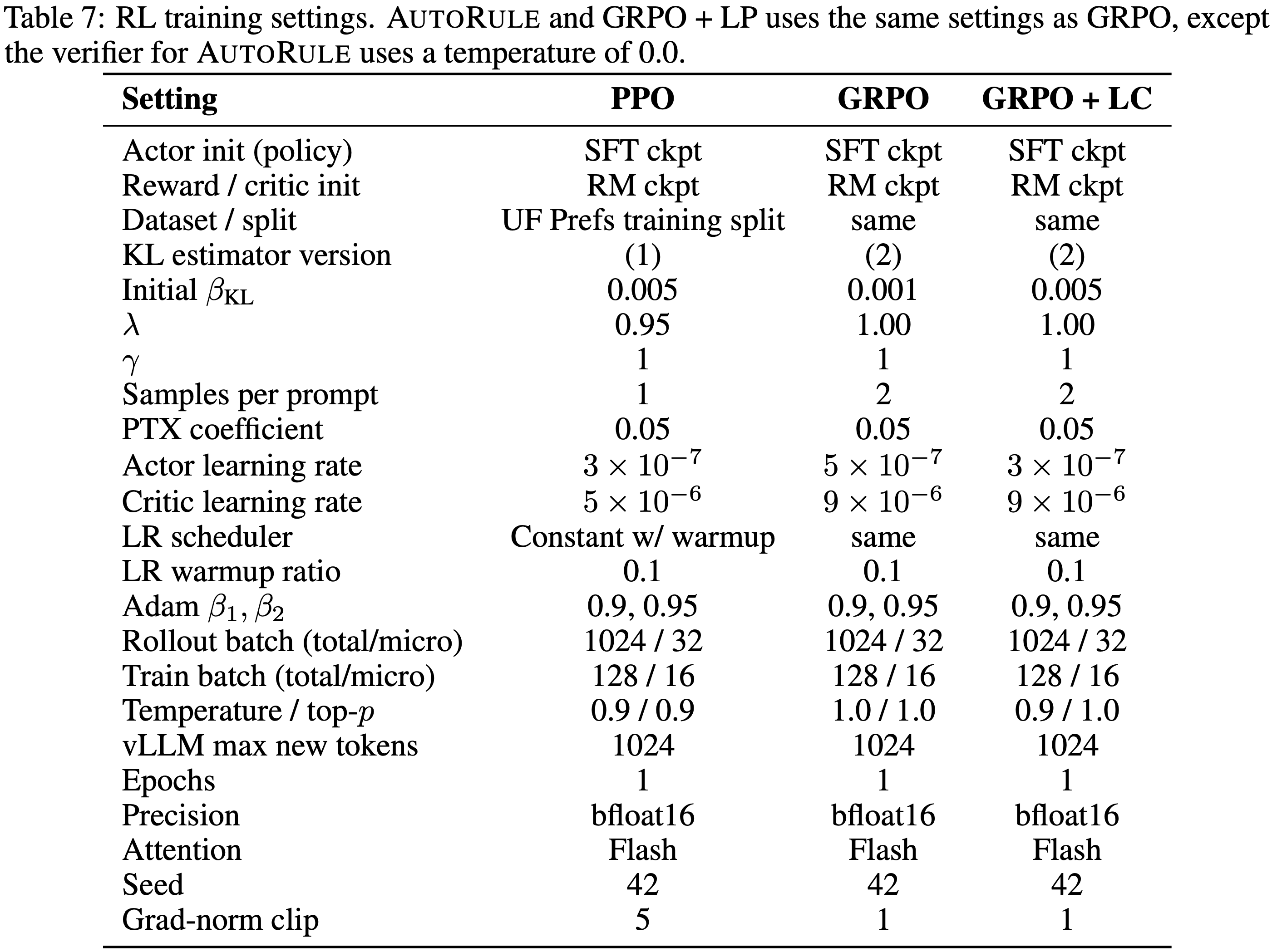
- 用于 SFT、奖励模型和 RL 训练的设置分别见表 5、表 6 和表 7
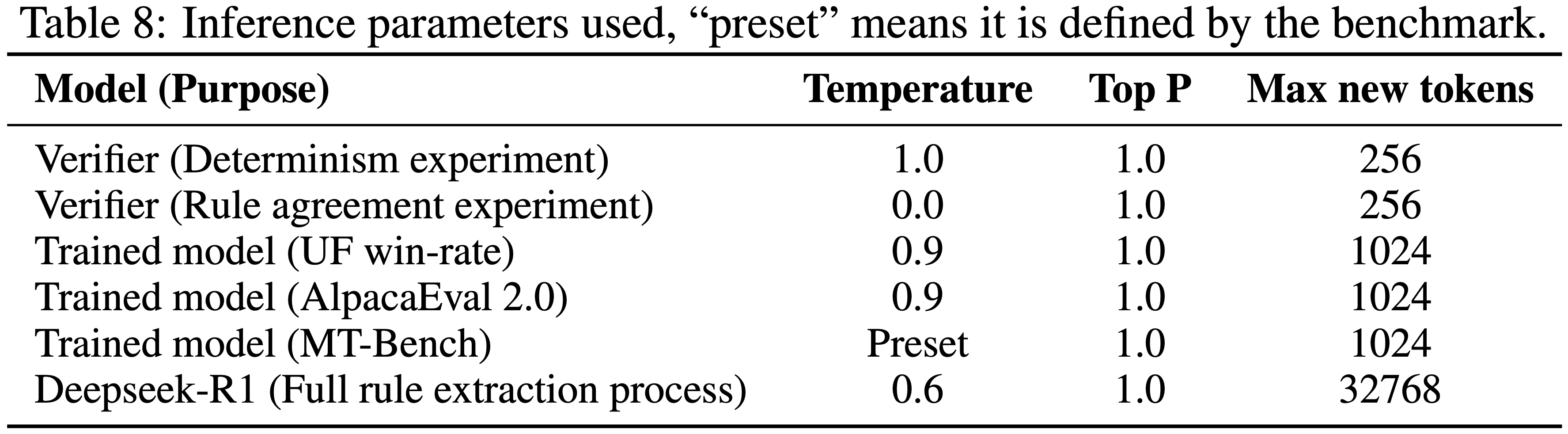
B.2 Inference parameters
- 推理参数见表 8
B.3 KL approximation
- 论文使用了 OpenRLHF (2024) 中实现的两种 KL 近似版本
- 第一种用于 PPO,第二种用于 GRPO
$$ {\log \left(\frac{\pi_{\phi}(y\mid x)}{\pi^{SFT}(y\mid x)}\right)} \tag{1}$$
$$ {e^{-\log \left(\frac{\pi_{\phi}(y\mid x)}{\pi^{SFT}(x\mid x)}\right)} - 1 + \log \left(\frac{\pi_{\phi}(y\mid x)}{\pi^{SFT}(y\mid x)}\right)} \tag{2}$$
B.4 Length penalty
- 为了实现长度惩罚,论文从奖励中减去以下项:
$$
\frac{1}{2}\left(\frac{\mathrm{response\_length} }{L}\right) - \frac{1}{2}
$$ - 其中 \(L = 300\) 是目标长度
B.5 GRPO Advantage estimation
- 为了提高数值稳定性,如 OpenRLHF 中的实现,论文使用了第 3.3 节中展示的优势估计公式的修改版本,如下所示:
$$
\hat{A}_i = \frac{r_i - \mathrm{mean}(\mathbf{r})}{\mathrm{std}(\mathbf{r}) + 10^{-9} }
$$
B.6 Dataset Filtering
- 遵循过滤过程并使用 (2025) 的代码,为了选择训练数据,论文进行过滤并仅包含满足以下条件的示例:
- Chosen 和 Rejected 的 Response 都少于 512 个 token, Chosen 分数高于 Rejected 分数,且任一 Response 中都不包含单词“confidence”
- 问题:512 个 Token 是不是太少了?
- 问题:Confidence 是什么?
附录 C: Rules
- 见表 9、表 10 和表 11
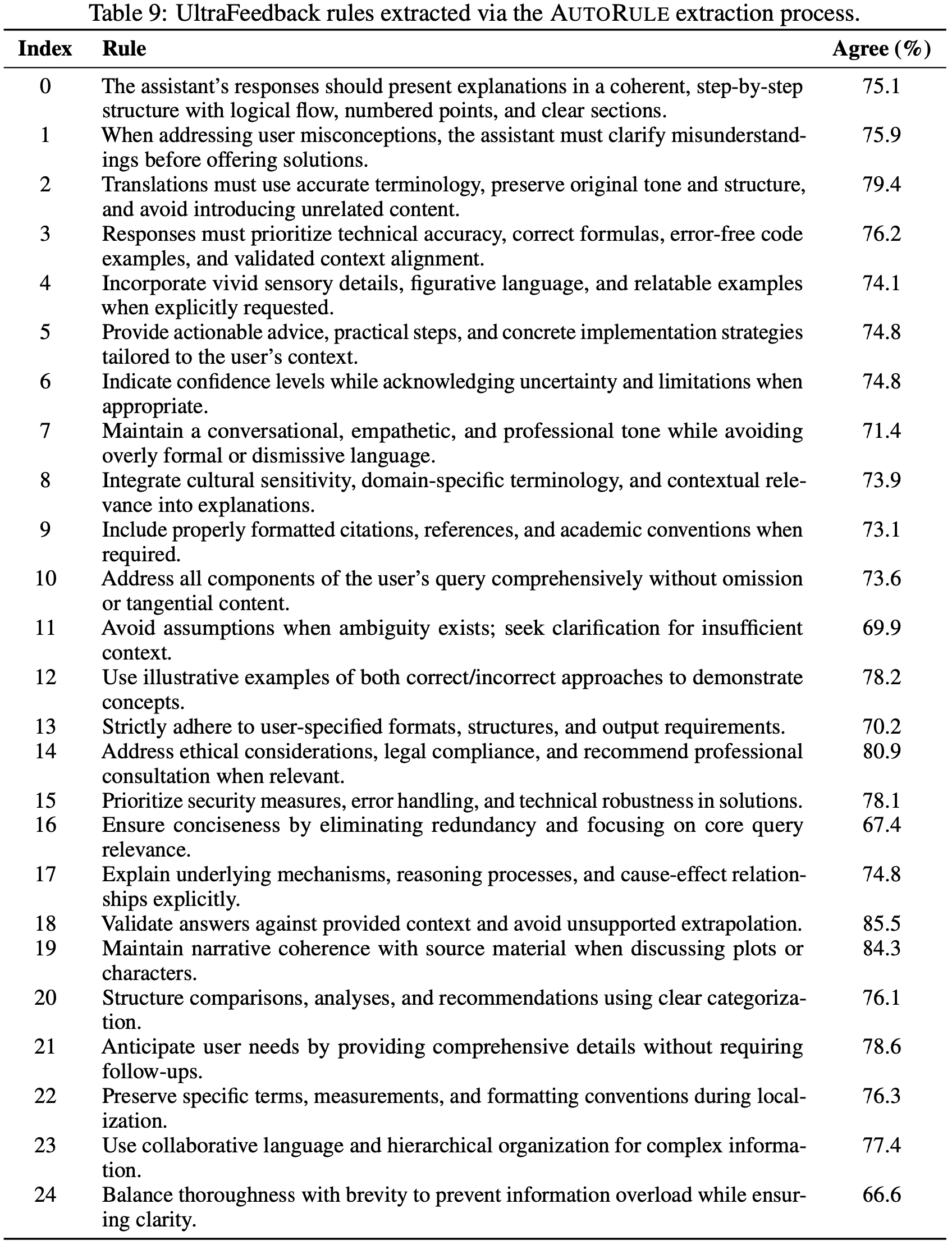
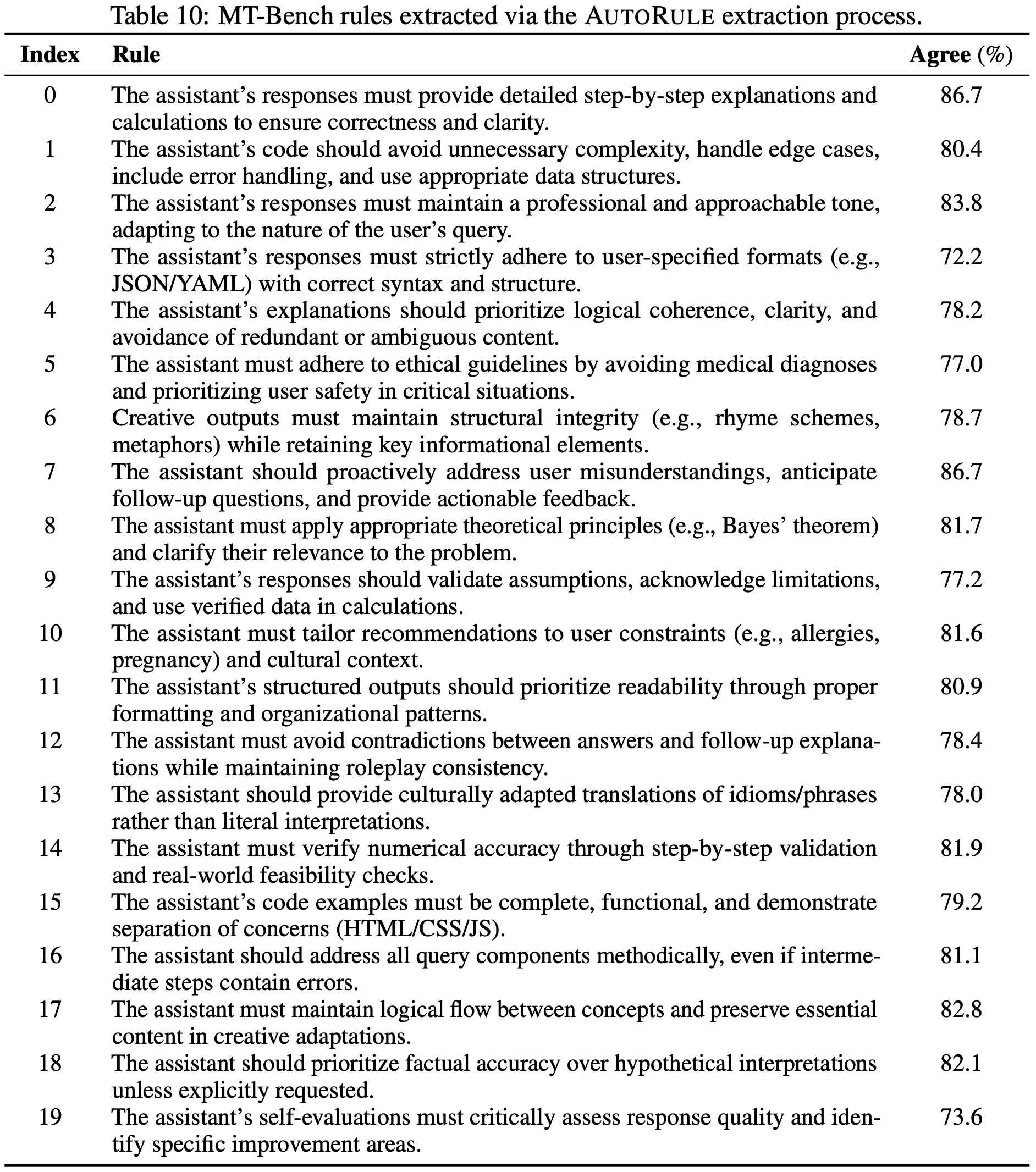
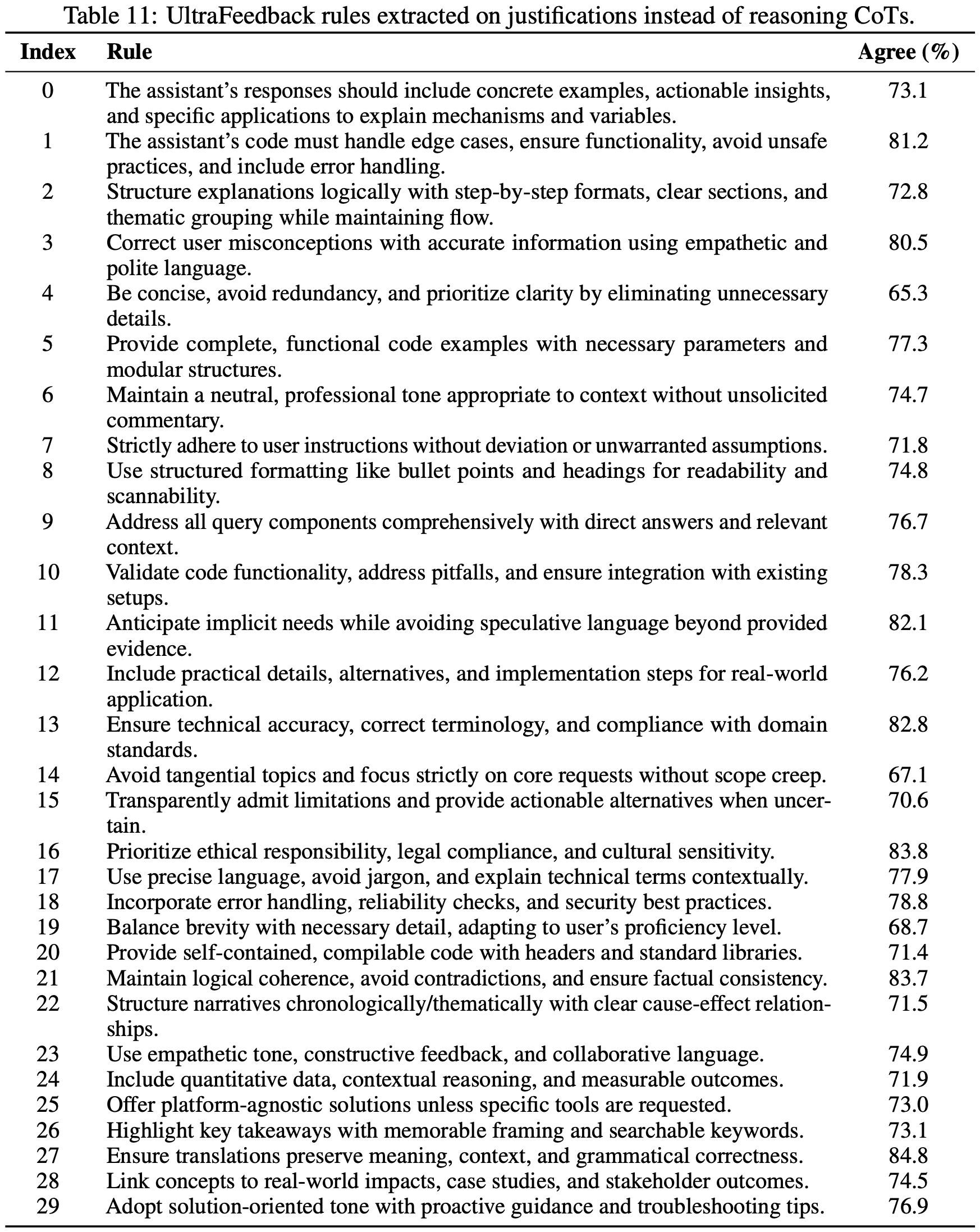
表 9(UltraFeedback 通过 AUTORULE 提取的规则)
英文版
1
2
3
4
5
6
7
8
9
10
11
12
13
14
15
16
17
18
19
20
21
22
23
24
25
26
27
[
"The assistant’s responses should present explanations in a coherent, step-by-step structure with logical flow, numbered points, and clear sections.",
"When addressing user misconceptions, the assistant must clarify misunderstandings before offering solutions.",
"Translations must use accurate terminology, preserve original tone and structure, and avoid introducing unrelated content.",
"Responses must prioritize technical accuracy, correct formulas, error-free code examples, and validated context alignment.",
"Incorporate vivid sensory details, figurative language, and relatable examples when explicitly requested.",
"Provide actionable advice, practical steps, and concrete implementation strategies tailored to the user’s context.",
"Indicate confidence levels while acknowledging uncertainty and limitations when appropriate.",
"Maintain a conversational, empathetic, and professional tone while avoiding overly formal or dismissive language.",
"Integrate cultural sensitivity, domain-specific terminology, and contextual relevance into explanations.",
"Include properly formatted citations, references, and academic conventions when required.",
"Address all components of the user’s query comprehensively without omission or tangential content.",
"Avoid assumptions when ambiguity exists; seek clarification for insufficient context.",
"Use illustrative examples of both correct/incorrect approaches to demonstrate concepts.",
"Strictly adhere to user-specified formats, structures, and output requirements.",
"Address ethical considerations, legal compliance, and recommend professional consultation when relevant.",
"Prioritize security measures, error handling, and technical robustness in solutions.",
"Ensure conciseness by eliminating redundancy and focusing on core query relevance.",
"Explain underlying mechanisms, reasoning processes, and cause-effect relationships explicitly.",
"Validate answers against provided context and avoid unsupported extrapolation.",
"Maintain narrative coherence with source material when discussing plots or characters.",
"Structure comparisons, analyses, and recommendations using clear categorization.",
"Anticipate user needs by providing comprehensive details without requiring follow-ups.",
"Preserve specific terms, measurements, and formatting conventions during localization.",
"Use collaborative language and hierarchical organization for complex information.",
"Balance thoroughness with brevity to prevent information overload while ensuring clarity."
]中文版:
1
2
3
4
5
6
7
8
9
10
11
12
13
14
15
16
17
18
19
20
21
22
23
24
25
26
27
[
"助手的回复应采用连贯的分步结构呈现解释,具备逻辑连贯性,使用编号要点和清晰的分段。",
"当纠正用户误解时,助手必须先澄清误区,再提供解决方案。",
"翻译需使用准确术语,保留原文语气和结构,避免添加无关内容。",
"回复需优先保证技术准确性、公式正确性、代码示例无错误,以及与上下文的有效契合。",
"当用户明确要求时,需融入生动的感官细节、比喻性语言和易理解的示例。",
"提供符合用户场景的可操作建议、实用步骤和具体实施策略。",
"在适当情况下,需说明置信度,同时承认不确定性和局限性。",
"保持对话式、富有同理心且专业的语气,避免过于正式或轻蔑的表达。",
"在解释中融入文化敏感性、领域特定术语和上下文相关性。",
"当需要时,包含格式规范的引文、参考文献和学术惯例内容。",
"全面回应用户查询的所有部分,不遗漏关键信息,不涉及无关内容。",
"当存在歧义时避免主观假设;若上下文不足,应请求用户补充说明。",
"通过正确和错误方法的示例说明,阐释相关概念。",
"严格遵守用户指定的格式、结构和输出要求。",
"涉及相关内容时,需考虑伦理因素、法律合规性,并建议专业咨询。",
"在解决方案中优先考虑安全措施、错误处理和技术稳健性。",
"去除冗余信息,聚焦查询核心要点,确保回复简洁。",
"明确解释潜在机制、推理过程和因果关系。",
"依据提供的上下文验证答案,避免无依据的推断。",
"讨论情节或人物时,保持与原始素材的叙事连贯性。",
"通过清晰的分类组织比较、分析和建议内容。",
"预判用户需求,提供全面信息,避免用户后续追问。",
"本地化过程中,保留特定术语、度量单位和格式规范。",
"针对复杂信息,使用协作性语言和层级化结构呈现。",
"在全面性和简洁性之间取得平衡,避免信息过载,同时保证表达清晰。"
]
表 10(MT-Bench 通过 AUTORULE 提取的规则)
英文版:
1
2
3
4
5
6
7
8
9
10
11
12
13
14
15
16
17
18
19
20
21
22
[
"The assistant’s responses must provide detailed step-by-step explanations and calculations to ensure correctness and clarity.",
"The assistant’s code should avoid unnecessary complexity, handle edge cases, include error handling, and use appropriate data structures.",
"The assistant’s responses must maintain a professional and approachable tone, adapting to the nature of the user’s query.",
"The assistant’s responses must strictly adhere to user-specified formats (e.g., JSON/YAML) with correct syntax and structure.",
"The assistant’s explanations should prioritize logical coherence, clarity, and avoidance of redundant or ambiguous content.",
"The assistant must adhere to ethical guidelines by avoiding medical diagnoses and prioritizing user safety in critical situations.",
"Creative outputs must maintain structural integrity (e.g., rhyme schemes, metaphors) while retaining key informational elements.",
"The assistant should proactively address user misunderstandings, anticipate follow-up questions, and provide actionable feedback.",
"The assistant must apply appropriate theoretical principles (e.g., Bayes’ theorem) and clarify their relevance to the problem.",
"The assistant’s responses should validate assumptions, acknowledge limitations, and use verified data in calculations.",
"The assistant must tailor recommendations to user constraints (e.g., allergies, pregnancy) and cultural context.",
"The assistant’s structured outputs should prioritize readability through proper formatting and organizational patterns.",
"The assistant must avoid contradictions between answers and follow-up explanations while maintaining roleplay consistency.",
"The assistant should provide culturally adapted translations of idioms/phrases rather than literal interpretations.",
"The assistant must verify numerical accuracy through step-by-step validation and real-world feasibility checks.",
"The assistant’s code examples must be complete, functional, and demonstrate separation of concerns (HTML/CSS/JS).",
"The assistant should address all query components methodically, even if intermediate steps contain errors.",
"The assistant must maintain logical flow between concepts and preserve essential content in creative adaptations.",
"The assistant should prioritize factual accuracy over hypothetical interpretations unless explicitly requested.",
"The assistant’s self-evaluations must critically assess response quality and identify specific improvement areas."
]中文版:
1
2
3
4
5
6
7
8
9
10
11
12
13
14
15
16
17
18
19
20
21
22
[
"助手的回复必须提供详细的分步解释和计算过程,确保正确性和清晰度。",
"助手提供的代码应避免不必要的复杂性,处理边界情况,包含错误处理机制,并使用合适的数据结构。",
"助手的回复必须保持专业且亲切的语气,适应用户查询的具体场景。",
"助手的回复必须严格遵守用户指定的格式(如JSON/YAML),确保语法和结构正确。",
"助手的解释应优先保证逻辑连贯性、清晰度,避免冗余或模糊内容。",
"助手必须遵守伦理准则,不提供医疗诊断服务,并在关键场景下优先保障用户安全。",
"创意类输出需保持结构完整性(如押韵格式、隐喻手法),同时保留核心信息要素。",
"助手应主动纠正用户误解,预判后续问题,并提供可操作的反馈。",
"助手必须运用合适的理论原理(如贝叶斯定理),并阐明其与问题的相关性。",
"助手的回复应验证假设条件,承认局限性,并在计算中使用经核实的数据。",
"助手必须根据用户的限制条件(如过敏史、孕期状态)和文化背景调整建议。",
"助手的结构化输出应通过规范格式和组织逻辑,优先保证可读性。",
"助手必须避免答案与后续解释之间的矛盾,同时保持角色扮演的一致性。",
"助手应对习语/短语进行符合文化语境的翻译,而非字面直译。",
"助手必须通过分步验证和现实可行性检验,确保数值准确性。",
"助手的代码示例必须完整可运行,并体现关注点分离原则(如HTML/CSS/JS的合理拆分)。",
"助手应系统地回应查询的所有部分,即使中间步骤存在错误。",
"助手在创意改编中必须保持概念间的逻辑连贯性,并保留核心内容。",
"除非用户明确要求,否则助手应优先保证事实准确性,而非假设性解读。",
"助手的自我评估必须批判性地分析回复质量,并明确指出具体改进方向。"
]
表 11(基于 UltraFeedback 的论证而非推理链提取的规则)
英文版:
1
2
3
4
5
6
7
8
9
10
11
12
13
14
15
16
17
18
19
20
21
22
23
24
25
26
27
28
29
30
31
32
[
"The assistant’s responses should include concrete examples, actionable insights, and specific applications to explain mechanisms and variables.",
"The assistant’s code must handle edge cases, ensure functionality, avoid unsafe practices, and include error handling.",
"Structure explanations logically with step-by-step formats, clear sections, and thematic grouping while maintaining flow.",
"Correct user misconceptions with accurate information using empathetic and polite language.",
"Be concise, avoid redundancy, and prioritize clarity by eliminating unnecessary details.",
"Provide complete, functional code examples with necessary parameters and modular structures.",
"Maintain a neutral, professional tone appropriate to context without unsolicited commentary.",
"Strictly adhere to user instructions without deviation or unwarranted assumptions.",
"Use structured formatting like bullet points and headings for readability and scannability.",
"Address all query components comprehensively with direct answers and relevant context.",
"Validate code functionality, address pitfalls, and ensure integration with existing setups.",
"Anticipate implicit needs while avoiding speculative language beyond provided evidence.",
"Include practical details, alternatives, and implementation steps for real-world application.",
"Ensure technical accuracy, correct terminology, and compliance with domain standards.",
"Avoid tangential topics and focus strictly on core requests without scope creep.",
"Transparently admit limitations and provide actionable alternatives when uncertain.",
"Prioritize ethical responsibility, legal compliance, and cultural sensitivity.",
"Use precise language, avoid jargon, and explain technical terms contextually.",
"Incorporate error handling, reliability checks, and security best practices.",
"Balance brevity with necessary detail, adapting to user’s proficiency level.",
"Provide self-contained, compilable code with headers and standard libraries.",
"Maintain logical coherence, avoid contradictions, and ensure factual consistency.",
"Structure narratives chronologically/thematically with clear cause-effect relationships.",
"Use empathetic tone, constructive feedback, and collaborative language.",
"Include quantitative data, contextual reasoning, and measurable outcomes.",
"Offer platform-agnostic solutions unless specific tools are requested.",
"Highlight key takeaways with memorable framing and searchable keywords.",
"Ensure translations preserve meaning, context, and grammatical correctness.",
"Link concepts to real-world impacts, case studies, and stakeholder outcomes.",
"Adopt solution-oriented tone with proactive guidance and troubleshooting tips."
]中文版:
1
2
3
4
5
6
7
8
9
10
11
12
13
14
15
16
17
18
19
20
21
22
23
24
25
26
27
28
29
30
31
32
[
"助手的回复应包含具体示例、可操作见解和特定应用场景,以解释机制和变量。",
"助手的代码必须处理边界情况,确保功能可用,避免不安全操作,并包含错误处理机制。",
"以分步格式、清晰分段和主题分组的方式逻辑组织解释,同时保持连贯性。",
"用准确的信息纠正用户误解,语气需富有同理心且礼貌。",
"保持简洁,避免冗余,去除不必要的细节,优先保证清晰度。",
"提供完整可运行的代码示例,包含必要参数和模块化结构。",
"保持与语境相符的中立、专业语气,不添加未经请求的评论。",
"严格遵守用户指令,不偏离要求,不做无依据的假设。",
"使用项目符号、标题等结构化格式,提升可读性和易浏览性。",
"以直接的答案和相关上下文,全面回应查询的所有部分。",
"验证代码功能,指出潜在问题,并确保可与现有系统集成。",
"预判用户的潜在需求,同时避免使用超出已有证据的推测性语言。",
"包含实际应用所需的具体细节、替代方案和实施步骤。",
"保证技术准确性、术语正确性,并符合领域标准。",
"避免无关话题,严格聚焦核心需求,不擅自扩大范围。",
"透明地承认自身局限性,并在不确定时提供可操作的替代方案。",
"优先考虑伦理责任、法律合规性和文化敏感性。",
"使用精准的语言,避免专业术语堆砌,并结合上下文解释技术词汇。",
"融入错误处理、可靠性检验和安全最佳实践。",
"在简洁性和必要细节之间取得平衡,适应用户的专业水平。",
"提供独立可编译的代码,包含头文件和标准库引用。",
"保持逻辑连贯性,避免矛盾,确保事实一致性。",
"按时间顺序或主题组织叙事,明确因果关系。",
"使用富有同理心的语气、建设性反馈和协作性语言。",
"包含量化数据、上下文推理和可衡量的结果。",
"提供跨平台兼容的解决方案,除非用户指定特定工具。",
"通过易记的表述和可检索的关键词,突出核心要点。",
"确保翻译保留原意、上下文和语法正确性。",
"将概念与现实影响、案例研究和相关方成果关联起来。",
"采用解决方案导向的语气,提供主动指导和问题排查建议。"
]
附录 D: Rule agreement matrices(Rule 一致性矩阵)
- 图 5: UltraFeedback 数据上的 Rule 一致性矩阵
- 图 6: MT-Bench Human Judgments 数据上的 Rule 一致性矩阵
附录 E: 案例研究:推理链与论证示例(Case study: Reasoning chain vs justification examples)
- 为了进一步分析使用推理链进行 Rule 提取的重要性,论文在图 7 中展示了一个关于询问动物园在动物保护中作用的 Prompt 的案例研究
- 在两个模型 Response 中,Response A 明显较差,因为它包含了一个不合时宜的反问句
- 虽然论证和推理链都提供了有效的观点,但推理链在提供这些观点时更加详细和逐步推进,包含了更多的例子和对文本的具体引用,而论证只提供了一个最终的总结
- 通过使用推理链,作者相信 AutoRule 能够提取出更好、更深入和更符合逻辑的 Rule ,因为推理链提供了逻辑论证,而非模糊的描述
- Figure 7: Case study: reasoning chain vs justification.
1
2
3
4
5
6
7
8
9
10
11
12
13
14
15
16
17
18
19
20
21
22
23
24
25
26
27
28
29
30
31
32
33
34
35
36
37
38
39
40
41
42
43
44
45
46
47
48
49
50
51
52
53
54
## User Prompt
What role do zoos and aquariums play in educating the general public about conservation efforts?
## Assistant A (Rejected)
Did you know that zoos and aquariums provide critical opportunities for conservation education?
When people visit these institutions, they learn about the dangers of habitat destruction, loss of
biodiversity, and environmental disruptions. Many zoos and aquariums also participate in conservation
efforts directly by breeding endangered species, supporting research, and protecting wild populations.
It’s essential that we prioritize education and conservation efforts to help protect our planet and its
amazing wildlife.
## Assistant B (Chosen)
Zoos and aquariums play a crucial role in educating the general public about conservation efforts.
They not only offer a visual representation of the animals and their natural habitats but also provide
valuable information about the animals, their behaviors, and the challenges they face in the wild.
Many zoos and aquariums also support research, conservation projects, and breeding programs for
endangered species. Additionally, they offer interactive exhibits and educational programs that engage
visitors in these conservation efforts.
## Reasoning Chain
The user wants to know why Assistant B’s conversation was preferred over Assistant A’s. I need to
compare both responses based on clarity, coherence, helpfulness, tone, and overall quality.
Starting with Assistant A: The response mentions that zoos and aquariums provide critical opportunities for conservation education. They talk about habitat destruction, biodiversity loss, and
environmental disruptions. They also mention breeding programs, research, and protecting wild
populations. The tone seems positive, ending with a statement about prioritizing education and
conservation. But maybe the structure isn’t as organized. They start with a question ("Did you
know...?") which might be engaging, but then list points without much flow. The information is there,
but maybe not as detailed or structured.
Now Assistant B: They start by stating the role is crucial, then break it down into parts. First,
visual representation and information about animals and their challenges. Then mention research,
conservation projects, breeding programs. Also include interactive exhibits and educational programs.
The structure here is more logical—each sentence builds on the previous, covering different aspects
like education methods, direct conservation work, and visitor engagement. The tone is informative
and straightforward without rhetorical questions. It feels more comprehensive.
Comparing clarity: Both are clear, but Assistant B is more structured, making it easier to follow.
Coherence: Assistant B connects the points better, moving from education to conservation efforts
to engagement. Helpfulness: Assistant B provides specific examples like "interactive exhibits,"
which gives concrete details. Assistant A mentions similar points but less specifically. Tone: Both
are positive, but Assistant A’s use of "Did you know" might come off as less formal, whereas B is
consistently professional. Overall quality: B’s answer is more thorough and organized, which likely
makes it more effective for the user seeking a detailed explanation.
## Final Justification
Assistant B’s response was preferred due to superior clarity, coherence, and depth of information.
Here’s why:
Clarity: Assistant B used structured points and avoided rhetorical distractions.
Coherence: Assistant B presented a logical narrative from educational content to conservation actions
and visitor engagement.
Helpfulness: It included concrete examples like "interactive exhibits" and "challenges they face in
the wild."
Tone: B maintained a focused, declarative tone. A’s "Did you know..." approach detracted from
professionalism.
Overall Quality: B was more comprehensive and detailed, effectively answering both the "how" and
"why" aspects of the user’s question.
附录 F: Prompts
论文分别在图表 8、9 和 10 中列出了用于提取过程的 Prompt
Figure 8: Justification (AUTORULE Extractor stage 1) prompt
1
2
3
4
5
6
7
8
9
10
11
## Justification Prompt
[Instruction]
You are tasked with analyzing two conversations between an AI assistant and a user. Based on the content,
please provide a detailed explanation of why the user might have preferred the winning conversation.
Please consider aspects such as clarity, coherence, helpfulness, tone, and overall quality.
[Conversation with Assistant A]
{conversation_a}
[Conversation with Assistant B]
{conversation_b}
[Winning Conversation]: {winner}
[Your Explanation]Figure 9: Rule extraction (AUTORULE Extractor stage 2) prompt
1
2
3
4
5
6
7
8
9
10
11
12
13
14
15
16
17
## Rule Extraction Prompt
[Instruction]
Based on the following reasoning about why conversation with assistant winner is better,
extract any rule-like statements implied by the reasoning that indicate this preference. Rulelike statements should be able to be judged objectively and deterministically. Below are a
few examples of rule-like statements:
Example 1:
- The assistant’s responses should validate any assumptions made with sufficient context and
examples.
Example 2:
- The assistant’s responses should not simply restate information provided by the user as its
answer.
Example 3:
- The assistant’s responses should have a structure that satisfies the user’s request.
Return the list as a JSON array of strings. Do not use “‘json“‘, just output the JSON array
directly. If there are no rule-like statements, return an empty JSON array.
[Reasoning]
{reasoning_chain}Figure 10: Rule merging (AUTORULE Extractor stage 3) prompt
1
2
3
4
5
6
7
8
9
## Rule Merging Prompt
[Instruction]
Below is a large list of rule-like statements regarding the behavior of an AI assistant. Some
of these rules might be duplicates or very similar in meaning.
Please merge them so that there are no duplicates or rules with very similar meanings.
Return the merged list as a JSON array of strings. Do not use “‘json“‘, just output the JSON
array directly.
[Rules]
{rules_text}在图表 11 和 12 中包含了用于 Rule 验证的 Prompt ,以及用于确定 UltraFeedback 胜率判断的 Prompt (见图表 13)
Figure 11: Rule verifier prompt
1
2
3
4
5
6
7
8
9
10
11
12
13
14
15
16
17
## Rule Verifier Prompt
You are an impartial judge. Determine whether the AI assistant’s response in the following
conversation both complies with the rule below and does so in a concise manner:
Rule:
{rule}
[Start of Conversation]
{conversation}
[End of Conversation]
[Analysis]
Base your judgment solely on whether (1) the response satisfies the rule and (2) the response does so in a concise manner.
Only respond with "[[Yes]]" if **both** conditions are fully satisfied. If either condition is not met, respond with "[[No]]". If the rule is not applicable to the task, treat it as satisfied.
Respond with one of the following options, and nothing else: "[[Yes]]" or "[[No]]".Figure 12: Rule verifier prompt (no conciseness)
1
2
3
4
5
6
7
8
9
10
11
## Rule Verifier Prompt (no conciseness)
[Instruction]
Please act as an impartial judge and evaluate whether the responses provided by an AI assistant in the following conversation satisfy the following rule:
{rule}
Be as objective as possible when evaluating the rule and do not evaluate other characteristics of the response.
If the rule is not applicable for this task, treat it as if the rule is satisfied.
You must provide your answer by strictly outputting either one of the following two options:
"[[Yes]]" or "[[No]]" and nothing else.
[Start of Conversation]
{conversation}
[End of Conversation]Figure 13: UltraFeedback win-rate judgement prompt
1
2
3
4
5
6
7
8
9
10
11
12
13
14
15
16
17
18
19
20
21
22
23
24
25
26
27
28
29
I want you to create a leaderboard of different large-language models. To do so, I will give
you the instructions (prompts) given to the models, and the responses of two models. Please
rank the models based on which responses would be preferred by humans. All inputs and
outputs should be python dictionaries.
Here is the prompt:
{{
"instruction": """{instruction}"""
}}
Here are the outputs of the models:
[
{{
"model": "model_1",
"answer": """{output_1}"""
}},
{{
"model": "model_2",
"answer": """{output_2}"""
}}
]
Now please rank the models by the quality of their answers, so that the model with rank 1 has
the best output. Then return a list of the model names and ranks, i.e., produce the following
output:
[
{{’model’: <model-name>, ’rank’: <model-rank>}},
{{’model’: <model-name>, ’rank’: <model-rank>}}
]
Your response must be a valid Python dictionary and should contain nothing else because
we will directly execute it in Python. Please provide the ranking that the majority of humans
would give.
附录 G: Compute Resources
- 所有训练均在通过 SLURM 作业管理的高性能计算集群上进行
- 所有运行均使用 8 个 Nvidia L40S GPU 和 64 个 CPU
- SFT 和 RM 训练运行有 256 GB 的 CPU 内存可用,而 RL 阶段有 512 GB 的 CPU 内存可用
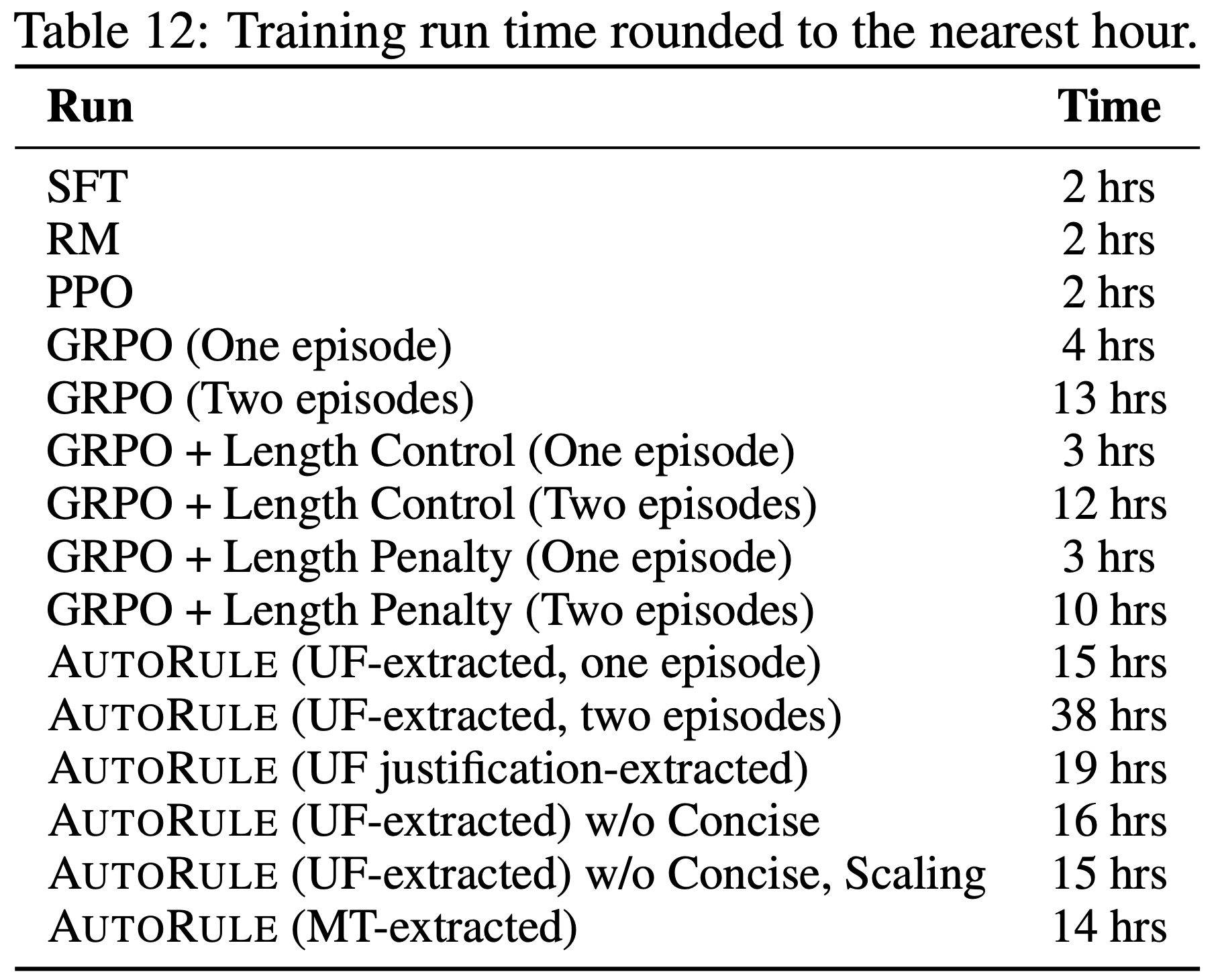
- 论文在表 12 中详细说明了每个训练运行的执行时间
附录 H: Licenses
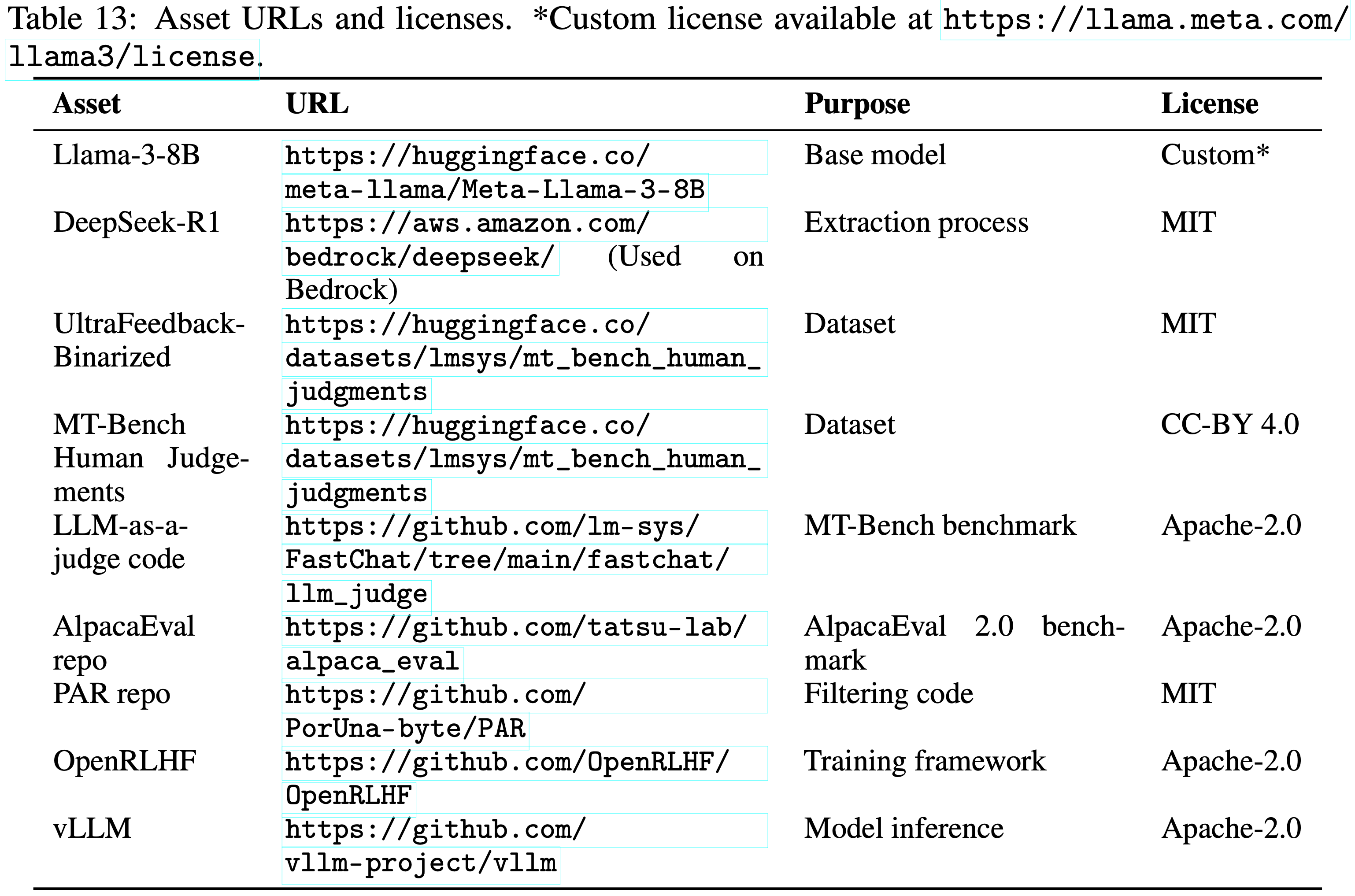
- 资产 URL(Asset URLS)和许可证见表 13